
By Destine Nde
On 15 July, the body of a woman was discovered in Kempton Park, Johannesburg. At that time, no one could foresee that this would be the first of nine bodies to be found in less than two months.
The South African Police Service (SAPS) are currently investigating the deaths of nine women across Ekurhuleni, east of Johannesburg. Four bodies were discovered in the past week alone. On Thursday morning, the ninth victim was found next to a road in Dawn Park. Like several others, she was half-naked, with multiple bruises and stab wounds.
The SAPS have not yet confirmed whether the deaths are connected, or whether a serial killer is responsible. Acting Police Minister Firoz Cachalia has discouraged speculation, stating that at this stage investigators are dealing with what appears to be ‘quite distinct, separate events’. And President Cyril Ramaphosa has called for patience, saying ‘our law enforcement agencies are working urgently to establish the facts’.
This has stirred outrage and paralysing fear in women across the country. And justifiably so: according to UN Women, women are being killed in South Africa at a rate five times higher than the global average. Last November, the government declared Gender Based Violence (GBV) a national disaster.
The gruesome discoveries have forced South Africa to revisit the same anxious question: how safe are our women? Who is responsible for protecting them, and who can be held responsible for these high levels of GBV? This issue has overshadowed the upcoming local government elections. Many people are criticising the government and the SAPS.
Perhaps understandably, local governments are also held responsible. However, in terms of the three-sphere governance system embedded in the constitution, policing is a national ‘competence’, meaning that provinces and local governments have no control over policing at all. (Among others, thi9s is why provinces and local governments cannot form their own police forces.) The best a local government can do is to collaborate with the local SAPS, and vice versa.
At this level, the Willowmore SAPS is a trail-blazer. Since taking over as station commander on 1 April this year, Lieutenant- Commander H.L. Winnaar has been collaborating in various ways not only with local government, but the entire community, in an effort to curb crime and make Willowmore a safer place.
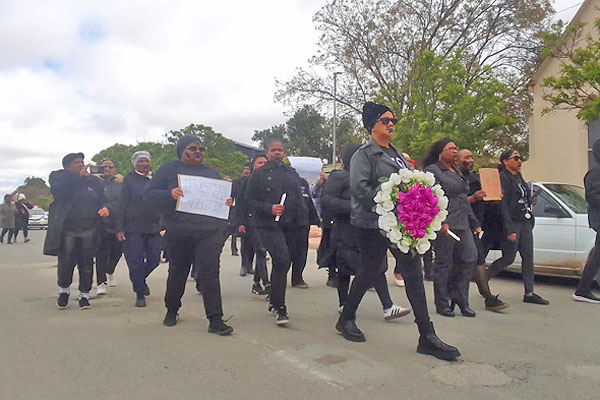
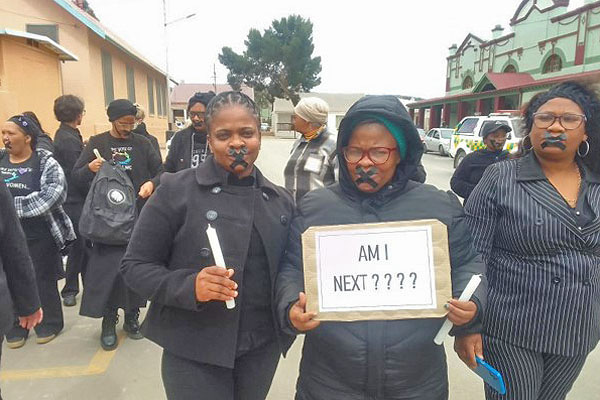
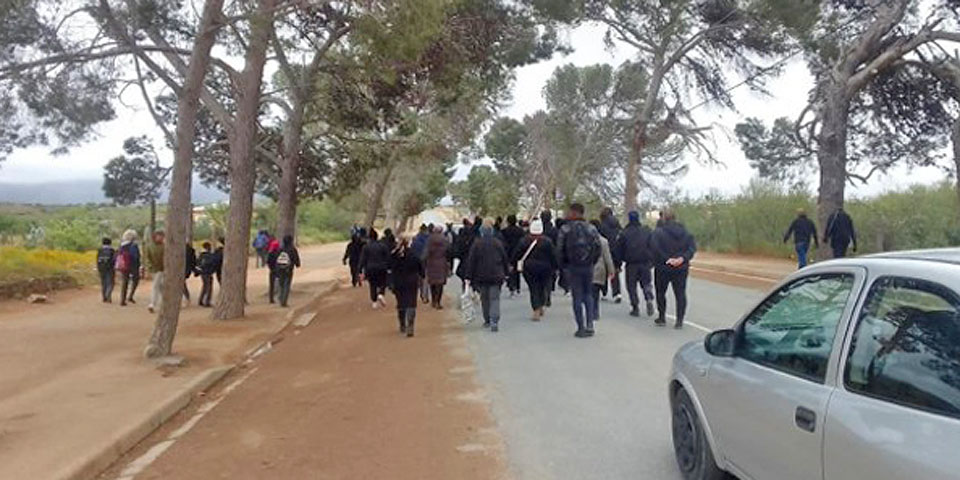
Among others, in the past week, she organised a community march in response to the Johannesburg killings, on the theme of ‘Willowmore Says No To GBV’. Participants carrying anti-GBV posters and flower ribbons wore black clothing, sealed their lips with black insulation tape, and marched from the police station to the end of town and back to Van Riebeeck Square, accompanied by a long convoy of law enforcement vehicles.
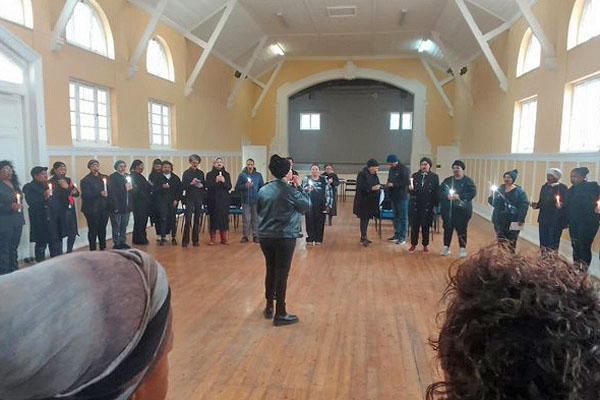
Afterwards there was a full programme in the Town Hall. It began with the lighting of candles, to show emphathy with the bereaved families on the East Rand. Standing in the centre of a wide circle, Lt Col Winnaar said: ‘Our candles are lighted because there are parents out there weeping, husbands grieving, children turned into orphans. We’re saying we share their pain and fears.’
In her keynote address, she said: ‘Today it’s a woman in Kempton Park. Tomorrow it might be me. South Africa is mourning.’
She also narrated shocking stories about sexual violence she had encountered in the course of her policing career.
She then urged the community to unite against GBV, among others by taking better care of their children, and to be aware of their whereabouts at all times. To her fellow women, she entreated: ‘As wives, mothers, girlfriends, we can’t party like men.’
She concluded by saying: ‘How many more bodies must turn up? How many more children, parents, husbands, must wait for mothers that will never return? Enough is enough! Fear cannot become normal!’
Other speakers were Constable Barkley, Community Policing Forum deputy chairperson Euna De Vos, and local area municipal manager Posche De Vos. In her address, Constable Barkley said: ‘The other night, I was afraid of walking home for the first time in seven years.’
After the event, I talked to the station commander. She agreed that the latest GBV crisis could influence voters’ perceptions of political parties in the upcoming elections. However, in her view, an unwillingness to speak out was the root of GBV. ‘Neither the president nor the police are failing us, but we ourselves. … These criminals live among us, but we won’t expose them.’
‘So are the government and police are not to blame at all?’ I asked.
She said ‘no’, explaining that most crimes took place in non-policeable areas – in other words, in places where the police are not present and cannot easily reach.
She added: ‘It all starts when parents remain silent to shield their children, wives to shield their husbands, and young girls withdrawing cases to free their boyfriends. For others it’s fear. We must break the chains of fear, which starts with trusting the police. I’m a woman and an ambassador against GBV. As a woman anyone can trust me. Change can only come from within ourselves.’
She is also seeking to be a ‘voice for the voiceless’. She said the inspiration to pursue a career in the SAPS came when she was still a child — due to personal experiences, ‘for GBV isn’t always physical’.
Since taking over as station commander, she has already done much to reduce crime and uplift Willowmore: a remarkable Mandela Day celebration, donation of sanitary pads to school girls, and the Holiday Fun Programme for children. Officers now pay R5 to dress casually on Fridays — Casual Fridays. The money goes toward buying more pads. The Social and Justice Departments have joined the initiative.
And there is plenty more on her agenda: a Heritage Day food programme for hungry kids, and an End of Year Performance Awards system, sikmilar to the Journey of Hope Awards project at her previous station in Cape Town for which she won various awards and sponsorships.
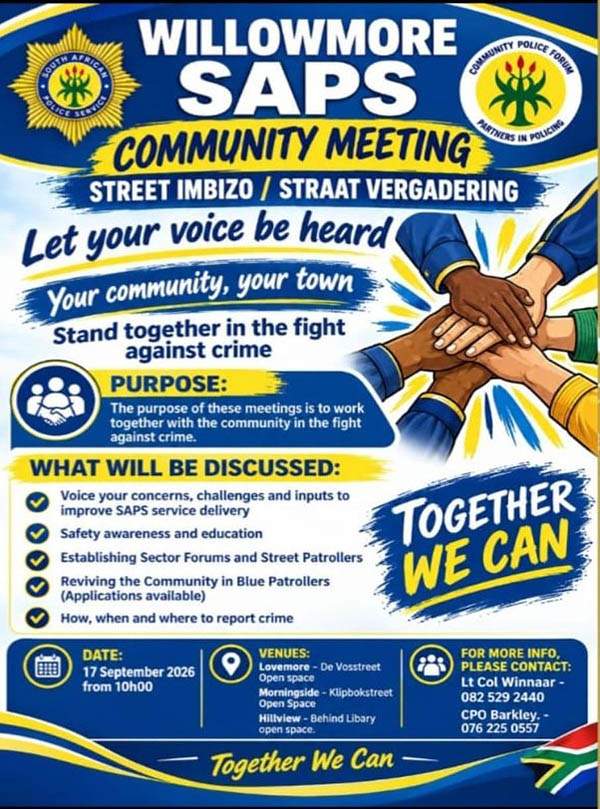
Just the day before the GBV march, she organised a street-by-street ‘imbizo’, aimed at mobilising community members to ‘stand together in the fight against crime’.
Her goal for Willowmore is real change: ‘I want to make Willowmore better and crime-free; for no one deserves to live in fear.’ She believes in preventing crime instead of responding to it, and that they key to this is public education.
Thus she said: ‘I have walked into every tavern, stopped the music, and warned patrons about alcohol-related crimes. Tackling drugs and alcoholism (B-crimes) helps prevent the violent A-crimes they often lead to. That is why this month our crime register is green — no crimes. And I’m not going to stop until I get Willowmore on the right track’.
President Ramaphosa has declared that ‘no stone will be left unturned’ in bringing those responsible for the East Rand murders to justice. However, while the role of the criminal justice system is obviously vital, the wave of killings on the East Rand has led to an increased realisation that beating the scourge of GBV will require a concerted effort by the entire South African community – and this small town in the Klein Karoo is pointing the way.
Featured image: GBV marchers proceed down an avenue in Willowmore. All photos: the author.