
By Riaan de Villiers
Soweto ‘76 will always be associated with a photograph – the image of a dying Hector Pieterson in the arms of an agonised youth in tattered overalls, Mbuyisa Makhubo, with Hector’s weeping sister, Antoinette, following close behind.
The photograph was taken by Sam Nzima, a photographer for the newspaper The World. It was shot with relatively simple equipment – a Pentax with a 50 millimeter lens. He managed to take six pictures – up to the point where Pieterson’s body was loaded into a World staff car, a Volkswagen Beetle, and taken to a local clinic, where he was declared dead on arrival.
The 13-year-old Pieterson was the second of two youths shot by dead by police in Soweto on the morning of 16 June – the other, who was probably shot first, was Hastings Ndhlovu. While historians are still debating the precise sequence of events, it is certain that rapidly spreading news of the shooting turned the protest by Sowetan schoolchildren against the imposition of Afrikaans as a medium of instruction into a violent riot.
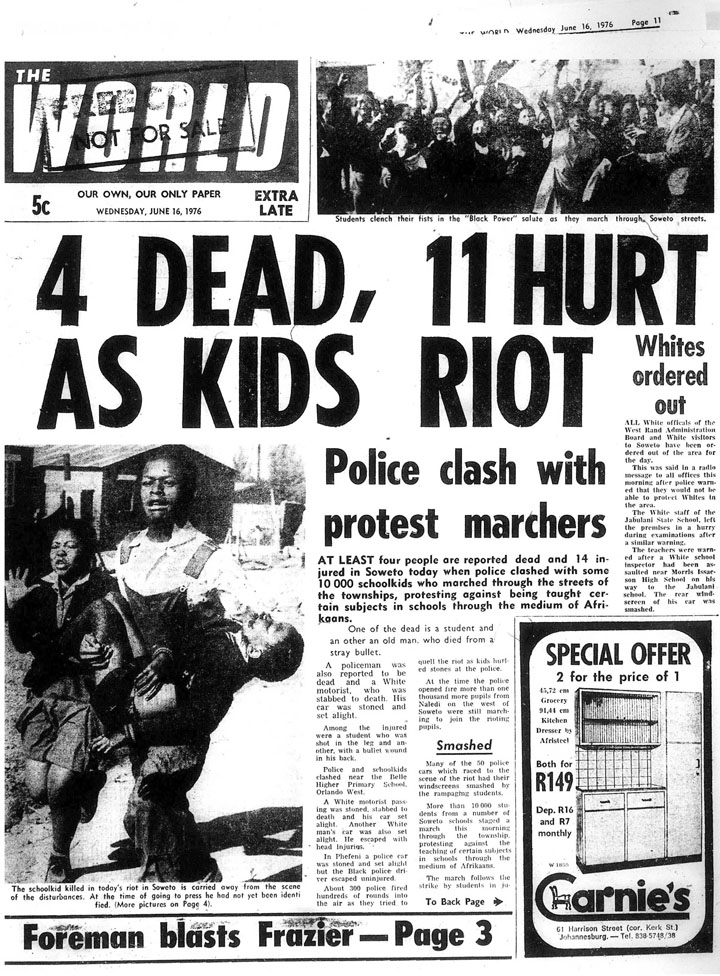
The front page of the newspaper The World on the afternoon of 16 June 1976.
The image was published on the front page of The World later that day. Given that the Argus company (which owned The World) had syndication agremeents with overseas newspapers, the image soon spread around the world. Its impact was far-reaching, both domestically and internationally – besides fuelling local outrage about the shootings, it greatly strenghened the international camapaign against apartheid, to the point where it is credited with helping to end white minority rule.
In 2016, Time Magazine declared it one of the 100 most influential images of all time. To read its item on this image, click here.
More information about the people in the photograph, as well as the photograph itself, is widely available on the internet. Briefly, Hector Pieterson was declared dead on arrival at a local clinic. Mbuyisa Makhubo went into exile, and disappeared. Antoinette (now Sithole) works at the Hector Pieterson memorial and museum in Soweto, where she has acted as a guide to thousands of local and international visitors, including heads of state and government.
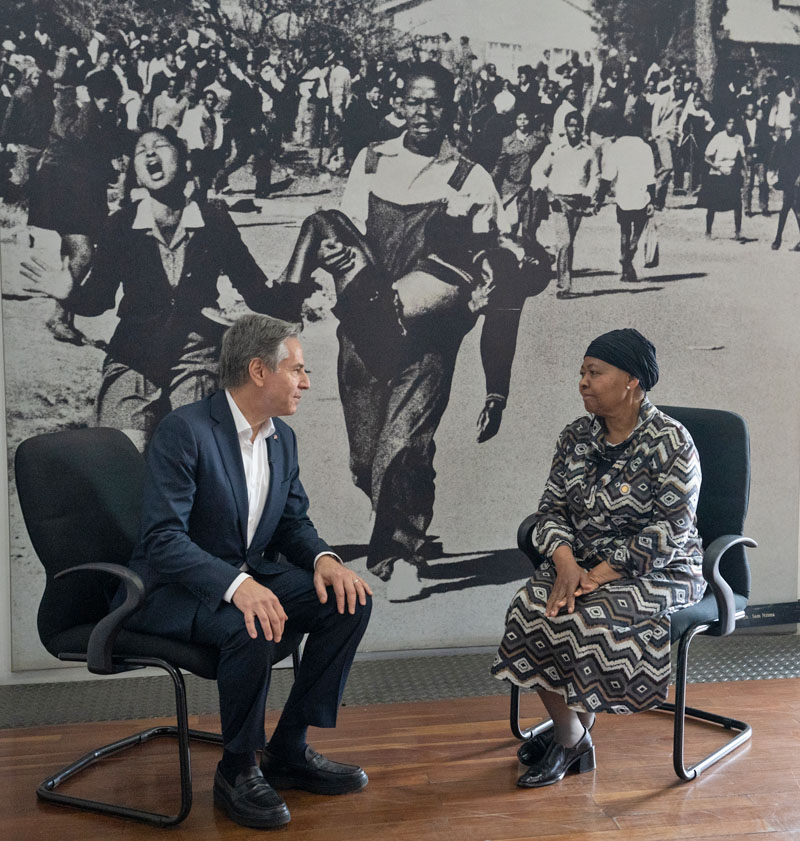
Antoinette Pieterson with the then US Secretary of State, Antony Blinken, in the Hector Pieterson Museum in August 2022. (US State Department / Freddie Everett on Flickr).
Nzima paid a heavy price for taking the picture. After harrassment by police – including death threats – he fled to his home village in the then Eastern Transvaal, and never returned, either to Johannesburg or his career as a photographer. Even there, he was placed under house arrest, and harassed by police for years thereafter.
The issue of copyright
An important part of the story of the photograph is that of copyright – a story that continues up to this day. Nzima was employed by The World, which belonged to the Argus Group of newspapers. As a result, as was customary at that time, copyright in the image was deemed to belong to the Argus Group, and Nzima did not benefit from its publication, either locally or its global syndication.
After a long legal battle, he recovered the rights to the photographs in 1998, but according to his son, Thulani, they were difficult to enforce.
Thulani has been quoted as saying that this delay cost his father huge amounts of money. ‘By the time we got the copyright, those who wanted to use the image for commercial purposes had already extracted the value.
“It also took about 18 years for our own government to recognise Sam Nzima as the man behind the picture. In that time, even our own government structures used the image without recognising copyright, and asking for rights to reproduce it.’
In 2011, Nzima was honoured with the bronze National Order of Ikhamanga. He died at age 83 in May 2018. According to Thulani, despite his father’s later recognition, he did not benefit significantly from the image in his lifetime.
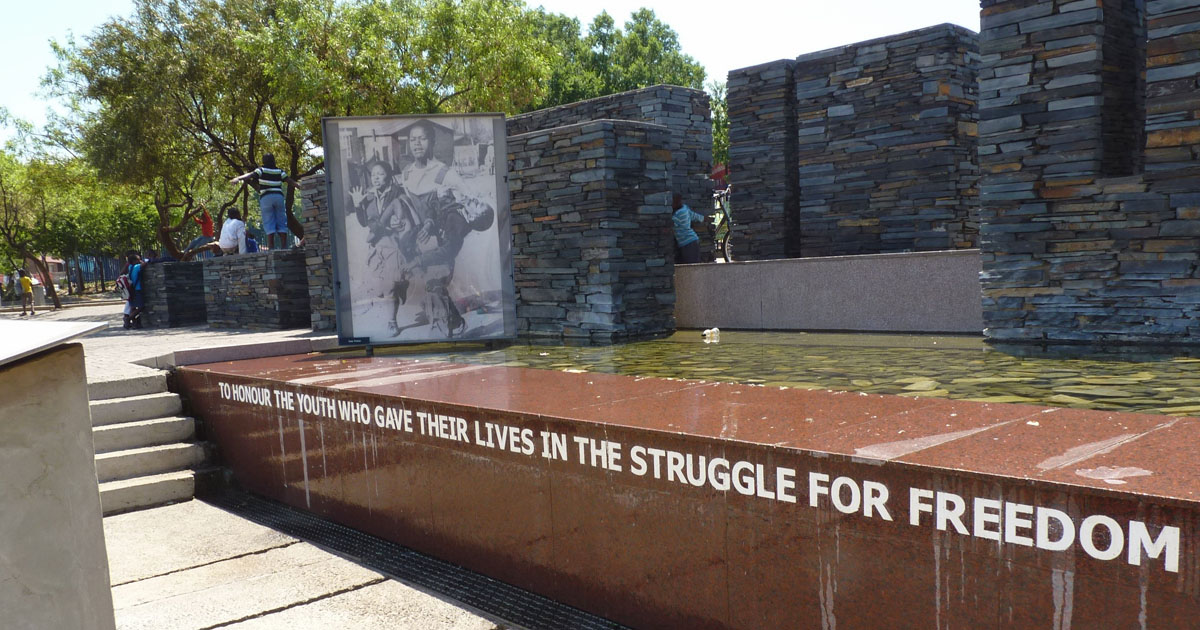
Readers are probably surprised by that fact that Nzima’s famous image has not been used to illustrate this article. (Instead, we have used pictures taken at the Hector Pieterson Memorial and Museum, with the image in the background.) The reasons are as follows:
According to current South African leglslation, copyright in a photograph expires at the end of the 50th year after first publication (or the 50th year after the death of the photographer). This means, as noted by Wikipedia, that copyright in these images will remain alive until the end of this year, and they may not be reproduced (in South Africa, at least) without purchasing rights of use or reproduction.
Following Sam Nzima’s death, copyright in the images is owned by the Sam Nzima Foundation, chaired by his son, Thulani, who, for a number of years, served as CEO of South African Tourism.
Rather surprisingly, rights of use are not currently being sold by any stock photo agency, but by the Foundation alone. (By contrast, rights of use of many historical photographs from that period are sold by stock photo agencies, which then remit some of the proceeds to the copyright holders.)
Copies of the image do appear on the internet, and can technically be downloaded, but reproducing them in any form – either in print or digitally — would be illegal, and could expose the transgressor to legal action and heavy damages.
Interestingly, this is the case in South Africa alone. US copyright law works differently, and according to Wikipedia – which carries a copy of the image which can freely be downloaded – it can be legally reproduced in the US on the grounds that it was ‘simultaneously published in several American newspapers without a copyright notice’ in a specific period.
Legal use today
To conclude, to legally use or reproduce this image in South Africa, one has to write to Thulani, in his capacity as chair of the Sam Nzima Foundation. This has been confirmed to me by Thulani himself, whom I spoke to on the phone on the morning of the 15th – a day before the anniversary. The Foundation does not currently have a website, and one has to send him an email.
In our case, there wasn’t enough time to do this, and in any case the costs of (one-time) reproduction would almost certainly exceed our modest budgets.
Thulani was driving at the time of our conversation, and we could not talk for too long. However, he did confirm to me the dismaying fact that the negatives had been lost (while still supposedly in the care of the Argus Company), and that all reproduction is taking place off a set of prints – an all too familiar story in respect of some of the most iconic photographs taken by black photographers in particular in the course of SA’s history.
FEATURED IMAGE: The Hector Pieterson Memorial in Soweto, with one of Sam Nzima’s famous photographs in the background. (Wikimedia Commons)