

A farmer in a checkered thrift shop shirt and kortbroek is standing at a cant at a petrol pump, while an attendant wearing an overall fills his bakkie.
Says the attendant: ‘Malema is the best.’
‘Ag nee man,’ scoffs the farmer, ‘if that guy comes into power, this [pointing at the R36/litre fuel price] will be R100 by Christmas.’
‘Nee, no, that man will change things,’ says the attendant, putting a lot of stress on change.
And so goes the exchange – each sticking to his guns and unwilling to back down, especially now that there’s an audience (which, to be fair, might have left the agricultural guy feeling a tad outnumbered) of people in cars listening in. Tank full, farmer hops into his bakkie, makes his last point, and drives off, while the attendant returns to manning his post.
In most places, this would not be regarded as remarkable, but here in the Karoo farmers are often seen as gruff, bulky Boers with hardline views who don’t take kindly to anyone having a different view. Now, on a balmy afternoon, such a man had a cordial discussion with someone from a different race and class, and each of them freely expressed his mind.
In nearby Kuyasa township, the sands are also shifting. Once an ANC stronghold, the local government election posters point to something that has been taking hold for a while. There are ANC candidates, obviously. But a strong EFF presence has also taken root in recent years and, quite surprisingly, previously obscure parties like ActionSA have also turned up. For the political establishment, this is an irritation. For the community, it speaks to several realities.
For the longest time, the ANC down here went about virtually unchallenged in black African communities. They not only ran the political show, but were also seen to be the gatekeepers to greater prosperity. If you wanted a job, you ingratiated yourself with the bigwigs. You attended the gatherings, posted favourably on social media, and made sure you avoided anyone who badmouthed the organisation and its leaders.
Even menial public sector employment – traditionally determined by randomly picking shuffled identity documents from a box – started showing signs of a political agenda. ‘Lists’ and ‘databases’ of people supposedly most deserving of RDP housing or jobs started creeping up. The same names were recycled in respect of jobs and other public initiatives. Community members started to notice this, began to complain, and when it seemed their dissatisfaction was not taken seriously, they took to the streets and began burning things.
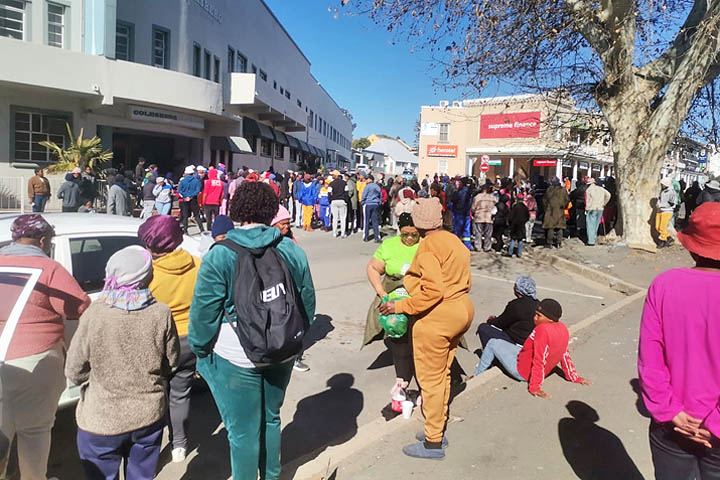
Lowryville residents during a protest outside the building of Colesberg’s Umsobomvu Municipality. Image: eparkeni.
Funds also bean to appear for the establishment of at least one residents’ association that began to challenge the ANC hegemony at the polls, and even bagged a few seats in Council. In many ways, this was a critical junction in this small town’s politics: it was a wake-up call for the powers that be, and helped the community to realise that there really is power in numbers.
Within the ANC, dissent arose, with community members sometimes voting for their own council candidates and rejecting those who had been suggested by the organisation. This was by no means an indication of the party’s downfall, but it did signify the start of something that the ANC could no longer control.
In the townships of Riemvasmaak and Lowryville, both the ANC and DA have discovered stiff competition in the Patriotic Alliance. Posters of Gayton Mckenzie’s outfit feature prominently here, with several candidates contesting several wards. His schtik of being the voice of ‘coloured’ people – who weren’t white enough during apartheid, and not black enough in the democratic era – seems to resonate with this community that has also spawned some protests in recent years.
Meanwhile, the DA’s Johan Matthee has been posting videos of sewage spills, and leading his party’s campaign. Despite his best efforts, however, the party is struggling to establish a meaningful foothold outside of the traditional ‘town’ – essentially, the business district and ‘white’ residentail areas. This could be attributed to old tropes and a way of life that just refuses to go away.
Leaving the ANC for, let’s say, the EFF is one thing. But going the way of either the IFP or DA might see you reminded of the political violence of the early 1990s in KwaZulu Natal, or snide references to being a baasboy.
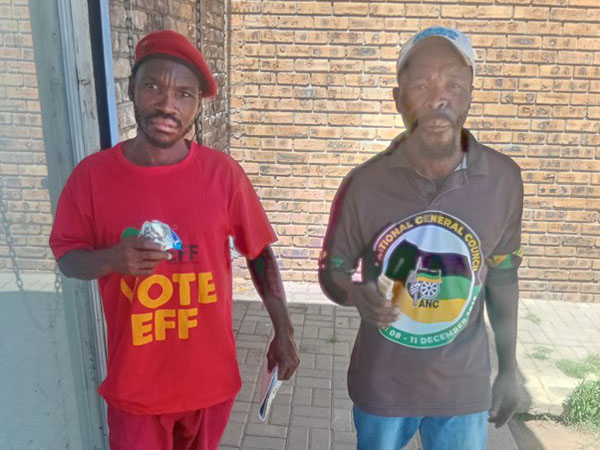
The brothers Bhuka support different parties even though they are family. Image: eparkeni.
But if there’s one thing that aptly describes the current situation in Colesberg, it is that in politics there is no such things as permanent enemies – and, by definition, friends. We have seen prominent local faces changing party colours or reuniting with erstwhile comrades. Here, like elsewhere, I suppose, politics has unashamedly become a game of thrones. No permanent loyalties, but a perpetual desire to rise above the ranks so as to pay the bills and get close to those who are calling the shots.
Ideology and principles are dead, and in their place stands good old human survival. It’s disheartening to watch, especially because of the spirit of selflessness that once prevailed among the anti-apartheid youths of the 1980s, culminating in the death of at least four. It is hard to see whatever they once stood for reflected in the way things are happening now.
For the ordinary resident, it’s all just a matter of voting for the party that will give everyone the same opportunities. The general sentiment is that the gatekeeping that has become synonymous with the ANC must be dismantled, hence the gradual emergence of alternative affiliations. Talk to people at the grass roots, and they will go on about how the wait for better material conditions has been far too long.
They speak of dreams deferred, and leaders that are deaf to the cries of the common man. On 4 October, Colesberg will be voting for pretty much the same things as voters anywhere else: service delivery, housing and jobs, but perhaps most importantly, they will also be voting for change. In their lives and those of their children.
FEATURED IMAGE: The political winds of change are blowing in this historic northern Karoo town.
This is an edited version of an article that first appeared on Phakamisa Mayaba’s website, eParkeni. Used with permission.