
By Destine Nde
Africa’s campaign in the 2026 FIFA World Cup has ended sooner than expected. With the expansion of this year’s tournament to 48 teams, Africa was represented by 10 countries, which not only boosted its presence, but also its chances of lifting the trophy. Given this, and with Morocco having finished third in 2022, many hoped a team from the continent would reach the final this year. But this was not to be. African teams progressed as follows:
Group stages
Africa performed impressively in the group stages, breaking some long-standing records. Nine of its ten teams qualified for the round of 32.
After a disappointing opener against Mexico, South Africa went on to finish second in Group A — for the first time ever. In Group G, Egypt, a seven-time African champion, won their first World Cup match in 20 years, and emerged second.
Another top performer was Cape Verde. The Blue Sharks finished second in Group H with 3 points. They drew all three group matches to progress to the knockout stage in their first-ever World Cup appearance.
Morocco, the first African team to smash the World Cup fourth round glass ceiling and reach the semi-finals, also impressed by topping Group C ahead of five-time champions Brazil. Ivory Coast managed to grab 6points in Group E to finish second as well.
The Leopards of DRC, the Black Stars of Ghana, the Desert Foxes of Algeria, and the Teranga Lions of Senegal all snatched their qualification tickets from the eight best third-placed slots.
The only African team to succumb in this round was the hapless Tunisia. Their football federation fired the head coach, Sabri Lamouchi, immediately after Sweden demolished the supposed ‘Eagles of Carthage’ by 5-1.
Round of 32
Africa’s round-of-32 performances were not remotely as good as those in the group stages: up to seven of them were heart-breaking to watch, and are now agonising to remember.
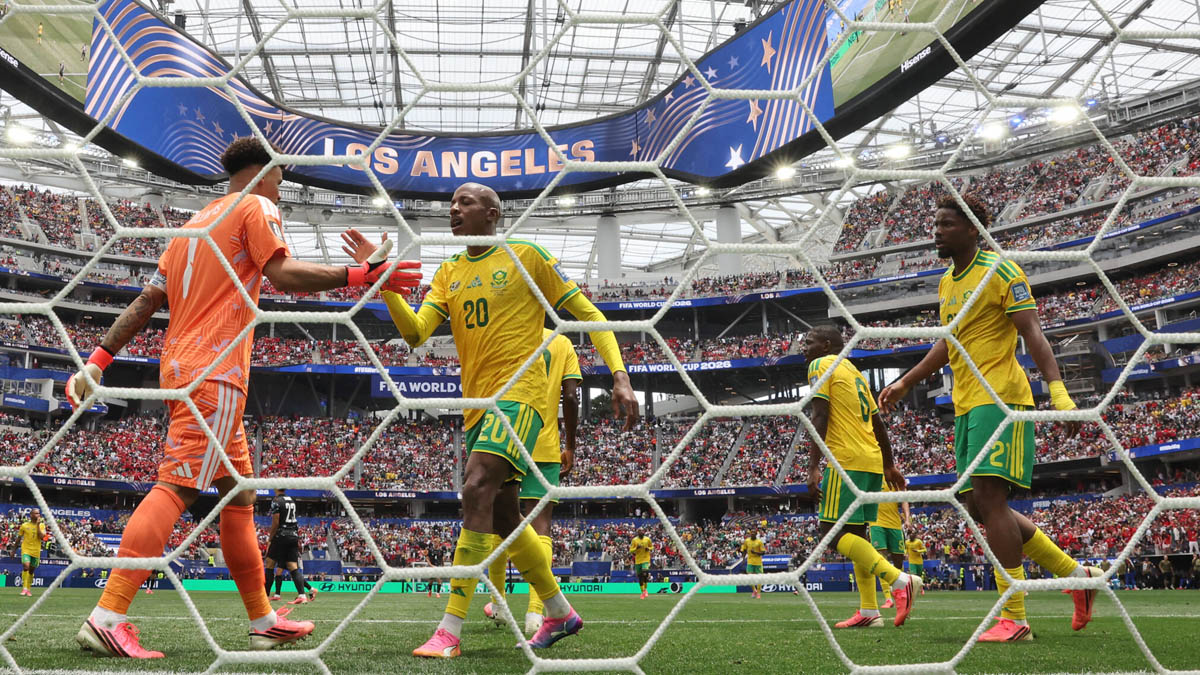
Bafana Bafana stifled Canada for 90 minutes, only to lose 1-0 in added time. The Elephants of Ivory Coast, too, were level with Norway on 1-1 for 86 minutes when they floundered and lost 2-1. DRC struck first against England, and defended the lead until the last quarter, when England scored twice within ten minutes to send them packing.
Senegal’s case was the worst. They dominated Belgium for almost 90 minutes. In fact, up to the 85th minute they enjoyed a 2-0 cushion, when suddenly Belgium scored twice in just over two minutes. The most painful part came in the last five minutes of extra time, when Belgium scored a contentious penalty to win 3-2 — one of the most historic turnarounds in soccer history.
As regards Cape Verde, everyone knew their clash with defending champions Argentina would be a classic case of David versus Goliath. Just by reaching the knock-out stages, the Blue Sharks had already surpassed even their own expectations. Their 1-1 draw against Spain in the group stages shocked the world. But their performance against Argentina in the knockouts was even more remarkable, and eventually more heartbreaking. Argentina only managed to score late in the game. Remarkably, Cape Verde struck back in the same minute, and Argentina eventually only won due to a Cape Verde own goal in the 111tth minute.
Algeria lost 2-0 fairly easily to Switzerland, and Ghana lost narrowly to Colombia one nil.
Only the two North African giants won their round-of-32 encounters. Morocco sent Netherlands packing with a 3-2 victory in penalty shootouts, and the Pharaohs of Egypt did the same to Austria, edging them 4-2 on penalties—their first-ever knockout win.
Round of 16
As expected, the Atlas Lions of Morocco roared again. They attacked in packs, striking three times without a reply from Canada: 3-0! This made them the first-ever African team to reach back-to-back quarterfinals.
Egypt against Argentina was essentially a repeat of Senegal versus Belgium. The Pharaohs threw away a 2-0 lead in the last quarter , and lost 3-2.
Quarterfinals
Morocco – the only African survivor – arrived in Atlanta with the momentum of not having lost a single game, wanting to go at least one step further than previously, and knowing they were the continent’s last hope. But France thrashed them 2-0 — effectively ending Africa’s 2026 dream.
Impressions
Despite everything, Africa achieved some momentous breakthroughs. Bafana Bafana, for example, received heroes’ welcomes back home, with thousands of excited fans thronging OR Tambo International Airport in Johannesburg on 2 July.
The reception awaiting the Blue Sharks at Nelson Mandela International Airport in Praia, Cape Verde, on 5 July – coinciding with their Independence Day—was even more rapturous. They had defied all the odds and surpassed all expectations in their Cinderella campaign. This included holding Spain to a goalless draw, prompting a dismayed Luis de la Fuente, Spain’s head coach, to say: ‘The reality of it still has to sink in. This is a World Cup. We know that, on paper, some teams are not better than us. and we thought we were far better than them. But then it’s a struggle to win.’
Actually, if one reviews all the matches, it’s easy to imagine that eight of Africa’s ten teams could have qualified for the round of 16. For instance, what if Senegal had held on to its 2-0 lead for only five more minutes? And what if Congo had defended its 1-0 lead just for 15 more minutes?
Experts’ opinions
According to analysts, the central issue plaguing African football is institutional instability. Doubtlessly the continent has immense talent, but lacks solid systems and competent institutions. For instance, Tunisia’s embarrassing run — conceding 12 goals in three matches, and returning pointless – has been attributed more to institutional instability than to a lack of talent. Herve’ Renard—the coach that replaced Sabri Lamouchi after their 1-5 defeat to Sweden—was Tunisia’s seventh coach since World Cup qualification began.
This has reignited debates over whether costly foreign coaches deliver better returns than domestic ones. But the performances of Morocco, Egypt, Cape Verde and South Africa have confirmed that the real issue is not home-grown or foreign coaches, but institutional instability.
For example, Morocco’s Mohamed Ouahbi is a domestic coach promoted after leading their Under-20 national team to a World Cup title. Since taking over, he has transformed the senior team into a global contender.
Egypt has also reached multiple milestones under the same domestic coach, Hossam Hassan – a first-ever World Cup win, a first knockout qualification, and a first knockout victory.
Pedro Leitao Brito (aka Bubista) is also a domestic coach. Under his guidance, Cape Verde has stunned the football world with thrilling performances. Besides winning CAF Men’s Coach of the Year 2025, Bubista’s credentials became unassailable after his team drew 1-1 with Spain and Argentina — the toughest opponents, since they are the finalists.
Bafana Bafana’s head coach, Hugo Broos, is Belgian. He has sated repeatedly that he is ‘very happy’ with his team’s performance, and South Africans, indeed, are elated. He has managed the team for five years. and stuck to his favourite 3-5-2 defensive formation over this entire period. He has been heavily criticised for this – particularly after Bafana’s poor showing against Mexico in the opening game — but it finally paid off.
Addressing the media after the win against Korea, he said: ‘I never listen to that thrash on social media. I do it my way’. Although his future still uncertain, he has urged Bafana Bafana to carry its World Cup momentum into the 2026 African Cup of Nations.
Thus three of the four African teams that delivered the best results were led by domestic coaches, which debunk the long-standing assumption that dependence on European technical expertise is a precondition for African success. Likewise, Bafana Bafana’s historic run proves too that coaching continuity matters.
Therefore, Mahfoud Amara of Qatar University, has written, ‘the continent’s next breakthrough will belong not simply to the nation with the best players, but to the one with the strongest football ecosystem’.
Popular opinion
The dominant popular opinion is that African teams suffered from a ‘fear of winning’. Both players and coaches have been heavily criticised for being unable to finish off games — sometimes with only five minutes left on the clock. Most teams had the potential, but lacked the culture of winning high-stakes matches against FiFA’s top-ranked teams, and standing up to last-minute pressure. It is still a surprise when an African team wins a World Cup match. Morocco’s 2022 historic semi-final run, among others, went down as a fairytale.
Going forward, therefore, Africa must cultivate a culture of winning against top teams on global stages. A winning mentality can reshape African football, and erase resilient stereotypes.
Besides others, these are the most robust lessons for Africans. Talent without institutional stability hits a ceiling, and competing without belief, without a winning mentality, is self-defeating. These, in essence, constitute the gap between Africa’s tremendous talent and its poor international results.
Otherwise, the continent risks squandering its talent base that has historically driven European teams to glory.
FEATURED IMAGE: A Bafana Bafana player shakes hands with the Canadian goalkeeper after the South African national team’s heartbreaking last-minute loss to FIFA World Cup co-hosts Canada on 29 June. Canada’s single goal in stoppage time knocked Bafana out of the tournament. Image: South African Football Association.
Coaches are very important to a team, but it appears that the reliance on coaches is too great. It is actually the players on the day who actually win or lose the game. In the case of Tunisia, each time they change the coach. 7 in total to the run up.