

By David Willers
What are we to make of a country, a modern liberal democracy, whose new prime minister is entirely unelected, and who is relying on a man with a rubbish bin on his head to demolish the political prospects of another man leading a right-wing surge? I mean, seriously? But that’s what’s happening right now in the United Kingdom.
The right-winger is Nigel Farage, MP, head of the Reform Party, who is facing a parliamentary inquiry into his financial affairs. The details are unimportant, but Farage decided the inquiry is an establishment stitch-up, and resigned his seat — Clacton, a coastal constituency in the east of ENgland. There will now be a by-election, with Farage standing again as a candidate and appealing to the electorate to support him against the transparently underhand establishment who, he says, will stop at nothing to shaft him.
Toverview readers familiar with the current European scene will detect echoes of similar ‘establishment’ manoeuvring against right-wing parties in France and Germany.
The problem for Farage is that none of the mainstream political parties in Britain are willing to play his game – the by-election is being boycotted by both the ruling Labour Party and the increasingly vocal Conservative Party in opposition.
Enter Count Binface, who has formally registered as a candidate, paid his deposit, and may even win the seat. The new prime minister, a fellow called Andy Burnham, has urged everyone to put their votes in the ‘bin’ – get it? – cue much laughter in the pub.
The rest of the world may look on incredulously at this clear evidence of British eccentricity, if not actual madness, but the phlegmatic Brits turn not a hair. Because, you see, it is all part of a wonderful satirical tradition which goes back hundreds of years in this ancient democracy.
As Millie Grainger of the Courtauld Institute in London has written: ‘Political satire, a time-honoured tradition of humour and critique, has been an indispensable force in British arts and culture. Defined by its ability to employ wit, ridicule, and artistic expression to skewer the powerful and question the status quo, political satire is not only an art form but a vital aspect of social commentary.
‘Through the lens of satire, British society has been able to laugh at, reflect on, and confront the complexities of its ever-changing political landscape. In this exploration of the evolution of visual political commentary, we delve into the rich tapestry of comedic dissent that has not only entertained but also provoked thought and discussion throughout history.’
Well, that is certainly true when you take a quick trawl through said history. Gulliver’s Travels, by Swift, is a good literary example, as is William Hogarth, who can be said to have invented the satirical cartoon we know today. His 1751 cartoon of Gin Lane in London, highlighting the consequences of excessive alcohol, is not for the faint-hearted; the dead child murdered by the gin-soaked mother who wants to sell the infant’s clothes for yet more gin.
As the years followed, we saw magazines like Punch hit the streets. Punch pulled no punches. Mercilessly lampooning the class divide and the rich, it succeeded in embedding black humour in the DNA of the English. It’s never gone away. Its a quality that means they never take themselves too seriously. Ridicule is what politicians fear most in Britain, then and now.
Countless cartoonists and lampooning publications ballooned in Victoria’s Britain, but it was really in the 20th century, when television entered the picture, that satire properly got the knife in.
The defining moment came with ITV’s Spitting Image in 1984, an outstanding, provocative, puppet show, satirising culture, all politicians (especially the unforgiving portrayal of then prime minister Margaret Thatcher and her cabinet), and the Royal family among other targets.
Thatcher’s character was addressed as ‘sir’ throughout the show which satirically presented her in close correspondence with an elderly Hitler, disguised as her Downing Street neighbour Herr Jeremy Von Wilcox.
These caricatured puppets took satire to its extreme; building on the grotesque cartoons of Hogarth and Punch. ‘Spitting Image’ used television to mock the British government using an entirely unprecedented approach.
We might say this represented the second phase of public satire in British life, the first being the influence of Hogarth and Punch magazine et al. Some 15 million viewers tuned in to ‘Spitting Image’ every week – a classic example of the reach of the electronic media, which has mutated into ever more sophisticated meme territory where Chat GPT allows users to produce unfiltered satirical images of politicians (not to speak of everything else!).
So effective has such digital reach become that, as we speak, there are powerful forces at work in the UK attempting to introduce regulatory measures to curb freedom of speech, just as there are in the USA. Of course, these are all humourless politicians.
But if we really drill down into the deeper layers of satire, which has kept politicians, monarchs, and other public figures in check, we might say that satirists have weaponised comedy, especially black comedy against authority. There are numerous hysterically funny radio shows on the go, especially where actors mimic the voices of politicians – a bit like ‘Spitting Image’ in soundbites.
All of this acts as a healthy lightning rod corrective to discourage British society from getting too het up about the kinds of issues that leads to routine riots in other European countries.
Good earlier examples of satire breaking taboos included Private Eye magazine (when Dr Verwoerd was murdered, its cover showed grinning Zulus with spears celebrating) – and of course Monty Python’s manic Flying Circus. Televisions’ ‘Yes Prime Minister’ was a hugely successful lampooning example of government taking itself too seriously.
Against this background and tradition of satirical mockery comes the equally colourful tradition of unserious candidates whose only purpose is to mock and puncture government policies and other candidates. There were several examples during the Victorian era of faux candidates – James Rush was one such, who had it in for self-important politicians. But the most influential example in our own times of a satirical election party was The Official Monster Raving Loony Party, founded by Screaming Lord Sutch, the rock musician in 1983.
The party’s platform aimed to puncture policy promises by other parties, inject humour into political debate, and demonstrate that elections had to remain open to unconventional voices. They argued in favour of such things as passports for pets and all-day pub opening hours — goals regarded as ludicrous at the time, and today a reality, amazingly.
So it is against the backdrop of this wonderful traditional celebration of scabrous humour, quintessentially English, rather than Scots or Welsh, that we have the arrival of Count Binface. Originally known as Lord Buckethead, but now Count Binface, his/her (nobody knows the bucket’s gender), Buckethead contests high-profile constituencies. The object is mainly to mock personality-driven politicians, Nigel Farage being a prime example.
The arrival of Count Binface (careful how you spell Count – ed) has decidedly up-ended Farage’s attempt to use the by-election as a protest against the establishment – parliament, in this case, which has a committee explicitly investigating his finances.
In fact, depending on how badly Farage fares against his redoubtable opponent, it could mean the sudden collapse of the entire Reform threat to both Labour and Conservative Parties, and restore the two party system to its rightful place.
So, three cheers for Count Binface ! If I could vote in that by-election, I’d mark my ballot paper for the shiny faced Count, if only for the hell of it!
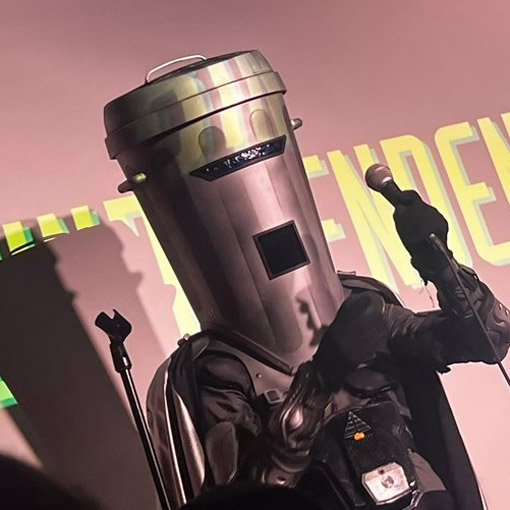
Count Binface in 2024. Image: Wikimedia Commons.
///////////////////////////////////
EDITOR’S NOTE:
So who is Count Binface, really? There’s an actual person in the bin – a 46-year-old writer and comedian named Jonathan or Jon Harvey. He is known as a ‘novelty candidate’ (also called as as satirical candidate, parody candidate or joke candidate), defined by good old Wikipedia defines as a ‘person who runs for political office in an election as a form of satire or protest, without seriously expecting to win’.
Harvey is by no means the first novelty candidate in British politics – it’s a tradition that goes back quite a bit. Binface himself has stood in numerous previous elections and by-elections, among others, against the previous prime ministers Boris Johnson, Theresa May and Rishi Sunak.
The media have had a field day, including the following inspired headline from CNN: ‘Farage left fighting a trash can as the UK populist leader’s election gamble backfires’.
And a British Substack author has written: ‘In the normal run of things, a by-election triggered by a sitting MP resigning a seat he’d won just two years earlier in order to re-contest it for the same party, would be the main story for that constituency. Yet thanks to the UK’s irrepressibly caustic view of life, our focus is quite rightly on a 5,900-year-old intergalactic space warrior from Sigma IX, who wears a dustbin on his head and has never, by his own admission, been to Clacton.’
He goes on to catalogue Binface’s campaign promises over the years, including;
- Nationalise model railways;
- MPs to live in the area they wish to represent for four years before standing for election;
- Corners in football to be refereed properly;
- Tries in Rugby League to be increased from four to five points, in line with inflation;
- Shops that play Christmas music before December to be closed down;
- All former prime ministers to perform National Service; and
- The hand dryer in the men’s toilets at the Crown and Treaty pub in Uxbridge to be moved to a more sensible position.
The Substack author describes the last-named pledge as ‘one of the longest-running unresolved infrastructure pledges in British political history. The pub is still there. The hand dryer, reportedly, has not moved.’
So here’s the thing: novelty candidates aren’t supposed to win – they’re just there to provide some light political relief. But given the bizarre state of British politics, including the fact that the major parties are boycotting the Clacton elections, the polls show that Count Binface might just make it. The mind boggles — among many other things, would he be allowed to enter parliament with the bin on his head? Would he be the same political persona without it?
Perhaps the last word – for now – belongs to Gary Lineker, soccer legend turned sports broadcaster, who said on a podcast called PodSaveAmerica: ‘If Count Binface wins, that will be the greatest day in political history. Let’s make it happen !’
FEATURED IMAGE: A political demonstration in East Anglia. Behind the satire, ‘novelty candidates’ often see their roles as encouraging political awareness and participation. Picture by Fred Murphy / East Anglia Bylines. Free to use under a Creative Commons license.
Farage vs Count Binface may be the most important by-election in the UK this century!