
De Rust is a tiny village nestled at the foot of the Swartberg (Black Mountain), which separates the Klein Karoo from the Great Karoo. It is situated at the southern end of the famous Meiringspoort (Meiring’s Defile), a pass running through a natural gorge in the mountains, connecting the regional centres of Oudtshoorn and Beaufort-West.
The Swartberg is one of the most exposed ‘fold’ mountain chains in the world, and the route offers breathtaking views of giant whorled peaks and deep green gorges. The pass itself slices through magnificent geological formations, crossing the same river 25 times in the course of its 25 kilometres. Moreover, much of the Swartberg is part of a UNESCO World Heritage Site known as the Cape Floral Region.
De Rust is situated at the southernmost end of the pass, thereby making it a gateway to the Great Karoo. While less than a kilometre long, its main road is always thronged with visitors.
Having travelled along this route numerous times, and been enchanted by it, I recently decided to visit De Rust to see for myself why it’s so popular with tourists and other visitors. I soon landed up in Herries Bistro and Bar, managed by Rina Herries.
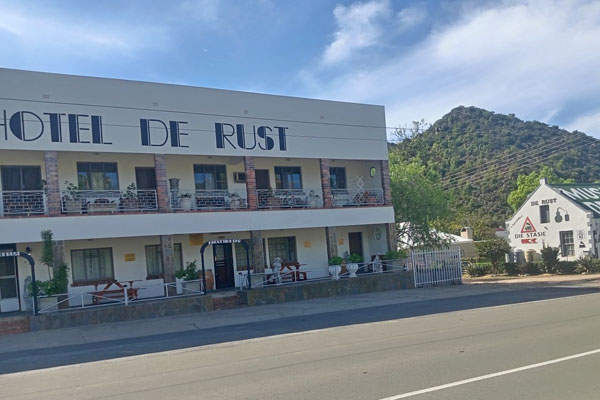
She explained that, due to its strategic location, De Rust was really a tourist and travellers’ town. ‘When people travel to Prince Albert or Oudtshoorn, for example, they stop here for refreshments.
‘Actually, it was a major resting place for early settlers. You can imagine how tiring it was for them to travel through the Swartberg without modern roads and vehicles. That’s why it’s called De Rust, the old Dutch term for ‘The Rest’. So De Rust is a place to come and rest a little. Indeed, it’s been a retirement home for many literary figures.’
Famously, De Rust was the home of C.J. Langenhoven, one of South Africa’s literary legends, and the the author of the poem ‘Die Stem van Suid-Afrika’ which became the lyrics of the country’s first national anthem.
In fact, Rina explained that Herries Bar was named after an imaginary elephant called Herrie, immortalised in Langenhoven’s beloved tale ‘Herrie op die Tremspoor’.
Apparently, Langenhoven found his inspiration at a spot now known as ‘Herrie se Klip’, a pink stone shaped like an elephant. He carved Herrie’s name into the stone, leaving a mark so well-known and enduring that it became a national monument in 1971.
Rina went on to explain that De Rust was an ideal place from which to explore much of the Klein Karoo. ‘That’s why it’s so busy, and our guest houses are frequently full. From here, you can quickly and easily get to all the big towns in the region – and, of course, explore our own surroundings.’
This includes the award-winning De Rustica Olive Estate, as well as numerous ostrich farms. Annual events include the Meiringspoort Marathon, an annual 21 kilometre marathon through the poort, due this year on the 18th and 19th of October.
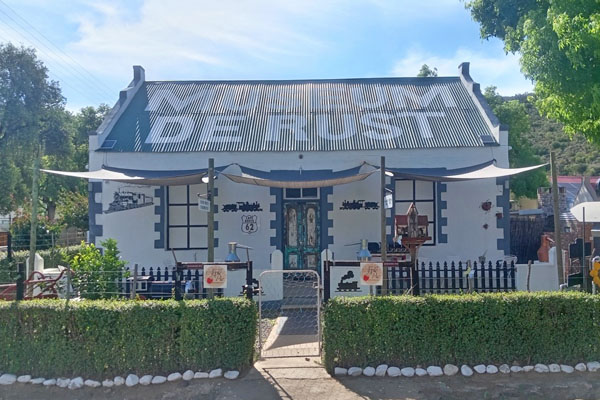
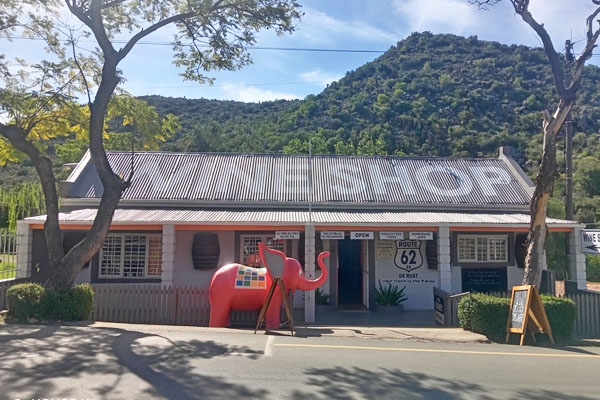
After my chat with Rina, my wife and I walked around the town, viewing its various attractions, including a museum, art gallery, wine shop (coyly featuring a pink plastic elephant on its stoep), restaurants, guest houses, and a tourism centre, among others. We returned home with my curiosity satisfied. De Rust certainly is a charming place to stop and rest awhile, and leaves one with happy memories.
FEATURED IMAGE: The foothills of the Swartberg (Black Mountain), home to the village of De Rust. (Wikimedia Commons)
What a delightful report on DE RUST. I so enjoyed the photographs of buildings of yesteryear.
Well done Destine.