
By Destine Nde
The severe storms of the past two weeks have wreaked havoc in the Eastern Cape, washing away roads and bridges, and disrupting electricity and water supplies. The scale of the devastation is massive.
It all began on Tuesday 5 May when torrential rains began to fall throughout the region, and continued virtually uninterrupted for more than a week, causing more and more damage.
A week later, on Tuesday 12 May, Eskom confirmed that heavy rainfall and strong winds had caused widespread damage to its infrastructure and power lines across the province. Areas without electricity included no less than seven district municipalities, as well as the Buffalo City Metro.
The full extent of the damage was still being established. While it had deployed additional resources to help restore power, some areas could not be accessed, and it was difficult to say when this process would be completed.
On Thursday 14 May, it said its teams were working tirelessly to restore power as safely and quickly as possible. Every effort was being made to address the remaining faults. Progress was being made ‘aggressively’ across the Eastern Cape, and additional teams were helping to speed up the process.
It added: ‘We understand the inconvenience and frustration these outages may cause, and want to assure you that every effort is being made to address the remaining faults and stabilise the network.’
This was putting it mildly. Willowmore was in the dark for seven days, from Wednesday 6 May until this past Thursday, mainly because the rains and subsequent floods had brought down power lines across the Baviaans Kloof. Older people said this was the longest continuous power outage since the town had been connected to the Eskom grid in 1984. Areas with broken poles remained flooded, and could not be accessed.
The economic impact has been devastating. Many shops and households have eaten, auctioned, or given away all their perishable stocks like meat, dairy products and fredsh vegetables (and some medicines too). At the same time, the breakdown of supply chains has made these goods scarce and more expensive. Those shops, butcheries and restaurants that use generators have spent a fortune on diesel every day.
All of this has been exacerbated by poor or no cel phone network coverage. Restaurants and the only garage in town have carried large posters stating: ‘No Cards — Cash Only!’ ABSA, the only bank in Willowmore, closed down on Friday the 15th. All the ATMs were offline, and people could not draw cash. On Mother’s Day, last Sunday, some people even contemplated travelling to other towns to draw money and do some banking.
Guest houses have stood still, because tourists have either left or cancelled their bookings. Local barbers, printers and tavern owners have been struggling. Some farmers are lamenting the loss of their livestock, and others the loss of fallen fruit and uprooted trees.
Suddenly, candles and firewood have become the most demanded merchandise. Many inhabitants rely on these for light, cooking and heating. A bag of wood now costs R25.30, and a canadle costs R5 Not many households can afford to spend about R100 per day on firewood and candles, when most of them are surviving on social grants. As a result, before dawn, the bushes around the town have been teeming with men and women of all ages collecting firewood.
Water is being rationed. Only 200 kilolitres of water is released from 5-9 am every day, and last Wednesday there was no water supply at all.
Willowmore’s main water source is the Wanhoop Dam in the Baviaans Kloof. There has been no electricity to power the water pumps, and it would be too expensive to keep the huge generators running all day. Only the hospital and the Old Age Home have been exempted. Schooling has also been interrupted.
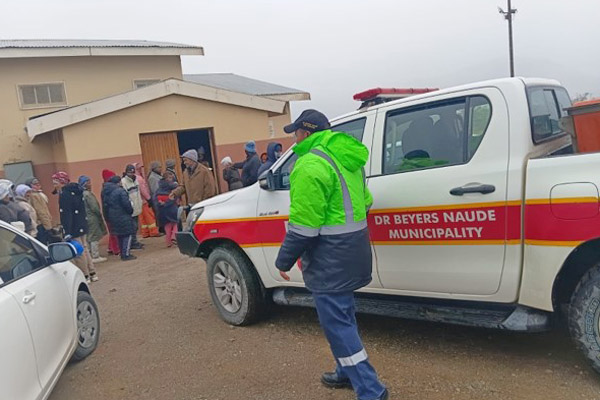
Residents queuing for food and blankets at the Willowmore Sports Ground.
Socially, residents have been partially cut off from the rest of the world. Phone batteries ran down, and cellular networks ceased to function, making it difficult for people to communicate.
Those in the Baviaans Kloof have been even worse off. Until a day or so ago, some 200 households were trapped in the Kloof. No one had been able to enter or to leave since the previous Wednesday.
The inhabitants of Baviaans Kloof come to Willowmore once a month to buy groceries. This was supposed to happen from Tuesday to Thursday last week, when social grants were being paid out. But the floods began on Tuesday morning, which brought this process to a standstill. In effect, they have been cut off with no power and no food.
Clearly, the situation in Willowmore and the Baviaans Kloof in particular has reached the level of a humanitarian crisis, justifying urgent intervention from the government and other stakeholders.
In fact, the severe weather events affecting several provinces has been classified as a national disaster. This is mean to unlock a coordinated response and recovery efforts across all spheres of government.
In a statement on 11 May, President Cyril Ramaphosa said he wanted to assure the nation that national, provincial and municipal authorities would ‘work with communities to address the effects of the disaster’. However, in Willowmore at least, this has not yet materialised.
Thus far, only the Gift of the Givers – a non-government organisation — has responded promptly and appropriately. On Sunday, with the assistance of the municipal road safety and fire-fighting departments, they handed out 300 food parcels to elderly people. Each elder also received a plate of hot food and a blanket.
On Monday they distributed medicine to the elderly in Baviaans Kloof. They also arranged for a pregnant woman to be airlifted out by helicopter, but this was ruled out by the adverse weather. Assisted by local farmers, the Road and Transport team created an alternative route into the Kloof, which also enabled the distribution of 160 food parcels.
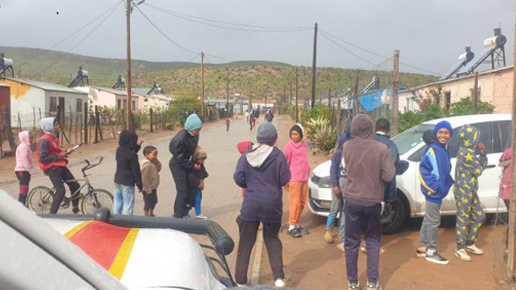
Children receiving food parcels in the Baviaans Kloof.
This route could only be traversed with four-wheel-drive vehicles, which are beyond the reach of poor people – the majority of those living in the Kloof. Therefore, they effective remain trapped without transport.
On Wednesday, Eskom managed to link Willowmore to the Kirkwood power supply line, just below the Aasvoël Mountain. However, the capacity of the line is limited, so a temporary rotation system has been set up, with various zones having power for three hours at a time at three-hour intervals.
At the time of writing – Saturday 16 May – this is where matters stood. Power was still supplied in three-hours intervals, and water for four hours every morning. It was clear that it would still take a long time before the town would return to normality.
Just a few weeks ago, farmers and religious leaders gathered in town to pray for rain. Heat and drought were making life a torment. Now the opposite is the case – everyone has been praying for the rains to stop and the sun to shine, so that the floods can subside, and the reconstruction begin.
This chain of events illustrates once again that, despite technological advances, humans are still at the mercy of the forces of nature. Given the onset and progression of climate change, this threat is likely to grow rather than to recede, presenting south Africa with multiple governance challenges. Events over the coming weeks will show to what extent the government’s disaster management system is coping with these challenges – especially in our predominantly poor rural areas.
In the meantime, Eskom seems to have made a creditable effort, at least in the Eastern Cape. On Friday 15 May – a day ago, at the time of writing — it announced it had made ‘huge strides’ towards restoring electricity to affected communities across the Eastern Cape. Repair teams had worked around the clock to repair powerlines and ensure that all major networks were back online. While most areas had regained electricity, technicians continued to address isolated faults and ensure that the system remained reliable. It added: ‘All teams on the ground are committed to bringing electricity back as quickly and safely as possible.’
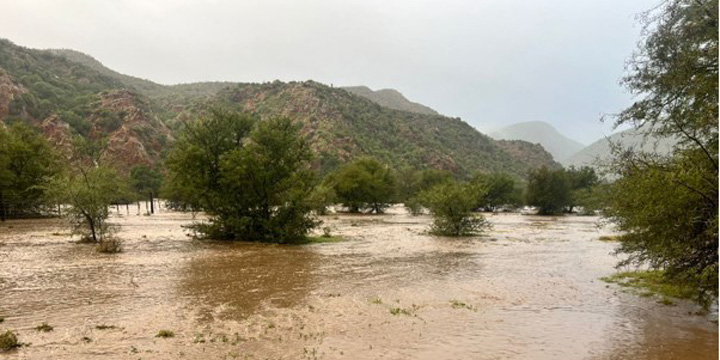
FEATURED IMAGE: Floods in the Baviaanskloof, which severed Willowmore’s power supply and trapped local communities.
So sorry to hear of this flooding and hardship for the Willowmore people … especially having recently passed thru their lovely little town en route to the Groote Winterhoek and Baviaanskloof mountains … leaving the area on Sunday 3 May and so only just ‘escaping’ the wrath of the storms.
And, yes, climate change is undoubtedly impacting our environment adversely with increased intensity and frequency of extreme weather events. This was predicted in the early 1990s when scientists were careful NOT to exaggerate such impacts. However, the actual impacts being experience worldwide now, are far worse that what they predicted then.
I did notice while there (pre this current flooding), that the Karroo was greener than I had seen it in years, with last year being very dry I believe. I do hope that the electiricity and normal life is restored to the locals as soon as possible – and thanks to the Gift of the Givers helping out meanwhile.
Thank you so much for an excellent post. I now have a sense of what it is like to be in Willowmore at this terribly difficult time. Wow.