
By Riaan de villiers
As the local government elections draw closer, the latest results of quarterly opinion polls conducted nationally as well as in three major metros have sent shock waves through the political establishment.
Conducted in July, the polls show that national ANC support has dropped to 34 per cent from 39 percent in the first quarter and 46 per cent in the 2021 local government elections, while DA support stands firm at 27 per cent, one percentage point down from the first quarter, and up from 22 per cent in the 2021 local government elections.
This means the gap between them has narrowed to a mere 7 percentage points. It also means that ANC support has almost halved from a high point of 65 per cent in the 2006 local government elections, to 34 per cent today.
In Johannesburg, support for the ANC has plummeted to 18 per cent, down from 30 per cent in the first quarter and 34 per cent in the 2021 local government elections, while the DA is at 42 per cent, up from 39 per cent in the first quarter, and 26 per cent in 2021. They are followed by the MKP at 13 percent, ActionSA at 10 percent, and the EFF at 8 percent. This means the DA could gain control of Johannesburg in coalition with ActionSA, for example, with Helen Zille as mayor.
In Tshwane, ANC support has dropped from 42 per cent in the first quarter to 32 percent, while DA support has dropped slightly from 45 percent to 43 percent. This means the DA could gain control of this metro in coalition with the Freedom Front Plus, with Cilliers Brink returning as mayor.
The quarterly polls have been commissioned by the Social Research Foundation in conjunction with the website The Common Sense, with the market research company Victory Research as service provider. The Common Sense is managed and edited by the political analyst Dr Frans Cronjé.
Cronjé has characterised the ANC’s electoral decline in vivid terms: ‘The data published by The Common Sense over recent days will make for difficult reading at Luthuli House,’ he says. The African National Congress (ANC) has surrendered half of its support over the past 20 years.
‘President Ramaphosa’s favourability has been cut in half too. Four times as many voters think he is guilty of a crime than those who believe he is not guilty.
‘Beyond the middle classes, the ANC has lost its majorities amongst black, poor, rural, and township voters.
‘The uMkhonto weSizwe Party (MKP) is on the march and now commands two thirds of the support the ANC commands among black voters. The ANC trails the Democratic Alliance (DA) by half in Johannesburg.
‘On current numbers, the Freedom Front Plus (FF+) and the DA will form a government in Tshwane. In Durban, the ANC is in third position behind the MKP and the DA.’
Cronjé goes on to argue that the ANC’s decline is not inevitable, and that, if it took a series of ‘relatively simple decisions’, it could restore its political majority by 2034. Essentially, he argues, it needs to take steps to improve investor confidence, which would boost investment, economic growth and job creation in turn.
The polls show there is ‘vast latent sympathy’ for the ANC, and its former supporters are ‘deeply saddened’ that they can no longer vote for it. ‘They really, really want to, but they say it has offered them no choice but to leave — it has chased them away.’
A major reason for this is the lack of jobs for young people, which is debilitating for them, and disappointing for their parents and grandparents.
However, there is a set of ‘relatively easy’ decisions that could get the ANC out of its current situation and back to control over the government and the state.
Surprisingly, he goes on to argue that this would be a desirable development. It would be a ‘strategic mistake – a misreading of the balance of forces’ – to say that South Africa’s political future was one of coalition governments. ‘The ANC could in its own right get back to a majority, and on its own terms. In many respects, that may be the best thing for South Africa as a unitary state.’ The alternative wojuld be the ‘balkanisation’ of South Africa as defined by the Union of 1910, which would be fine for the middle classes, but very destabilising, and further worsen the position of the poor.
////////////////
By vivid contrast, the political analyst Prince Mashele believes the ANC is heading for oblivion. Addressing the ninth Biznews conference in the Darkensberg, Mashele – who once wrote speeches for Thabo Mbeki – declared:
‘The ANC will continue to decline across the board. Given the results of the most recent polls, it’s a foregone conclusion.’
This was not a momentary decline — among others, he had predicted it more than a decade ago in his book The Fall of the ANC.
‘The ANC is in the process of dying. So those of you who love the ANC, bid it goodbye. There will be no ANC in the South African government after the 2034 elections.’
Among others, he went on to say that, contrary to the perceptions of some, the continued existence of African liberation movements in post-independence dispensations was not inevitable or assured.
This included Kenneth Kaunda’s United National Independence Party, which dominated Zambian politics from independence in 1964 until 1991. ‘Today, you will hardly find a UNIP office – Kaunda’s party is gone.’
/////////////////
So there we have it. What do our readers think? Please let us know in the comments below. For what it’s worth, this writer thinks the ANC is way past its sell-by date – an old-style liberation movement that has largely failed to adapt to the demands of a modernising constitutional democracy and has stayed on for far too long, hogging the drinks table, at the post-liberation party. …
///////////////
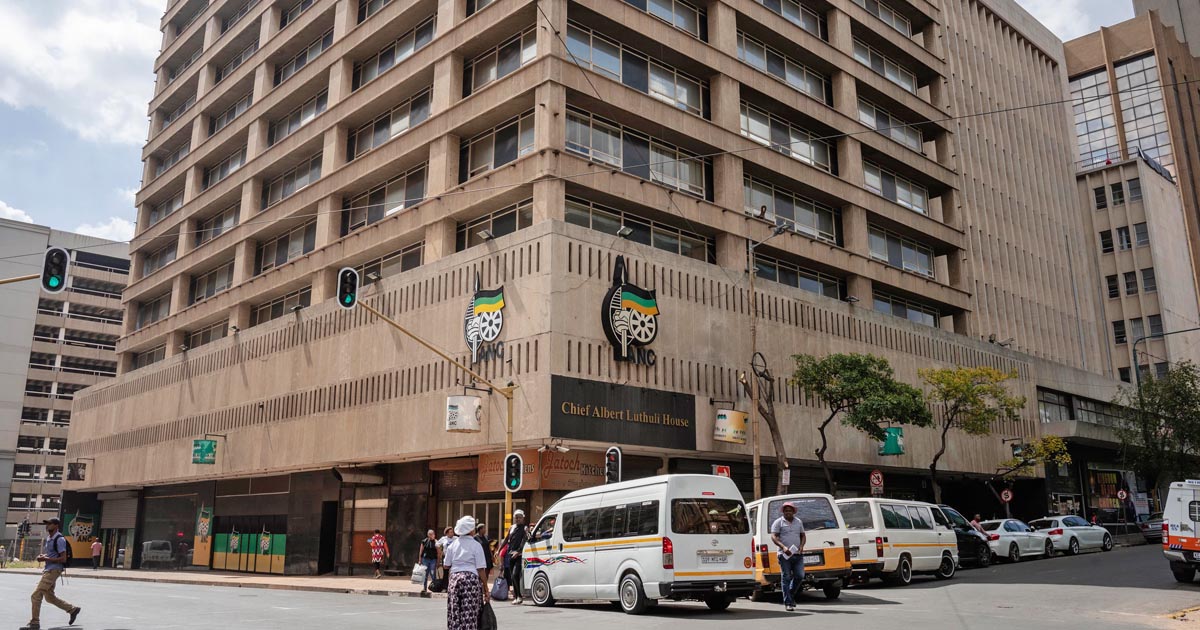
FEATURED IMAGE: Chief Albert Luthuli House in Bree Street, Johannesburg, which houses the national headquarters of the ANC. Ihsaan Hendricks / GroundUp.