
Phillip van Niekerk
I was among the 68,000-strong crowd at M&T Bank Stadium in Baltimore two weeks ago, watching the Springboks defeat the New Zealand All Blacks 43-28 to win the Test Series 3-1. A scintillating match and a truly splendid day.
While there was a smattering of black New Zealand jerseys, the overwhelming garb was the green and gold worn by Springbok supporters. The demographic was obviously affluent — not many people could afford the tickets, never mind the travel — and largely white. Judging by the accents, many of them were Afrikaners, though a number of black Saffers were there sharing the party atmosphere.
The feeling of goodwill turned electric when everyone stood and joined in the national anthem, sung by Jesse Clegg, son of the late, great ‘white Zulu’ Johnny Clegg. That’s something you can’t take away from South Africans wherever they are in the world. But I did think: only a few miles away in Washington DC, the Trump administration has welcomed thousands of white Afrikaner refugees on the premise that they are victims of a persecution so horrible that they are the only refugees in the whole world being let into the US.
Would white South Africans, especially Afrikaners, be singing the national anthem with such gusto if they were the targets of such a crime against humanity by their own government?
A few days later, Secretary of State Marco Rubio announced that the US would be imposing visa restrictions against those South Africans ‘responsible for or complicit in race-based discrimination, incitement of violence, and land expropriation without compensation.’ He did not say which South Africans would be targeted. They will only find out when their visa applications are denied.
Ambassador L. Brent Bozell III, who a few days earlier had sung the praises of the Springboks and speculated about a future National Football League fixture to be played in South Africa, added sternly that this was only the first step in a series of measures meant to ‘show America’s firm resolve on this matter.’
The White Cross project
All of this was a prelude to another group of South Africans making their way to the nation’s capital, led by Dr Ernst Roets, a central figure behind the Afrikaner persecution narrative. Despite being a marginal figure in South Africa, his lobbying efforts along with those of his allies have been largely adopted by the Trump administration as its South Africa policy.
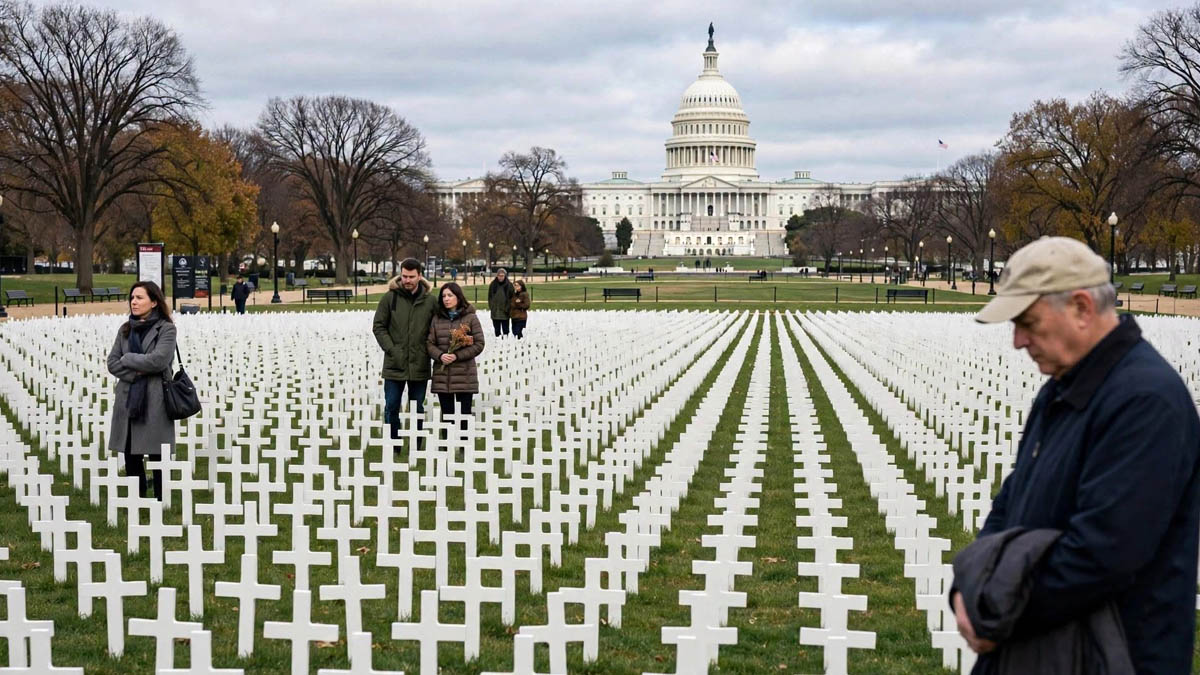
This was reinforced when, on Friday and Saturday, his Lex Libertas group, along with the New York Young Republican Club, planted 3,000 white crosses on the National Mall in Washington to mark those murdered on their farms since 1990.
This was preceded by a conference on the ‘White crosses project’ whose South African speakers included David Ansara, CEO of the Free Market Foundation, Martin van Staden, Editor of the Race Law Index, free-speech advocate Mark Oppenheimer, and James Myburgh, the editor of Politicsweb.
The crosses evoked Donald Trump’s dramatic Oval Office ambush of President Cyril Ramaphosa last year when he dimmed the lights and showed a video of a roadside demonstration of white crosses, implying that it was a mass burial site: proof of the white genocide he has repeatedly accused the South African government of perpetrating. But the Afrikaner genocide claim has been widely debunked, not least in the media, and a memorable investigative piece by Anderson Cooper on CBS’s 60 Minutes earlier this year truly laid it to rest.
Let’s be clear: every one of those deaths should be mourned. Lex Libertas lists 2,203 farm murders in the 36 years since 1990, and South Africa has an abysmal record of crime prevention in that period. It’s not clear who gets to be included in the list. What it certainly excludes are the more than 150,000 South Africans, most of them black, who have been murdered in South Africa over that same period. Their crosses were not planted on the National Mall.
While he sidesteps the term ‘genocide’, Roets allows the fiction to live on in the feverish swamps of Washington because he hopes to use the support of the Trump administration as leverage to advance his political agenda: constitutional change to provide, in some form or other, for a white ‘volkstaat.’ This is really a version of the old Verwoerdian grand apartheid scam, except this time it will be Afrikaners creating their own autonomous ethnic homeland.
Following Rubio’s sanctions, Cameron Hudson, an Africa analyst and critic of South Africa’s foreign policy, wrote: ‘South Africa has become the bogeyman in certain conservative/white nationalist circles in the US as the natural end state of the kinds of woke/Diversity, Equity and Inclusion policies that the Administration is really at war with.’
White nationalists of the world unite
The sanctions against South Africa and the planting of crosses on the Washington Mall speak to a deep-seated connection between the white nationalist politics of both South Africa and the United States.
The joint sponsors of the cross-planting event, the Manhattan-based New York Young Republican Club, are not to be confused with the New York State Young Republicans, whose extremely racist and antisemitic group chats were leaked last year. Peter Giunta, then chairman of the state group, wrote in the chat that he loved Hitler, called blacks monkeys, and joked about putting his political opponents in gas chambers. After the chats were published, the Republican Party in the state disbanded the organisation.
But the New York Young Republican Club, co-hosts of the White Cross Project, is not free of scandal either. The guest list at its annual gala in December last year included figures with documented histories of antisemitic or white-nationalist rhetoric: Jared Taylor, editor of the white supremacist website American Renaissance; Vish Burra, a former staffer of the disgraced Congressman George Santos, who’d posted a video depicting Jews as cockroaches; the antisemitic streamer Sneako; and roughly twenty lawmakers from Germany’s far-right AfD party. Neo-Nazi Nick Fuentes reportedly tried to gatecrash the event but was turned away at the door. Jewish City Councilwoman Inna Vernikov, who’d been promoted as an ‘honoured guest,’ pulled out of attending over concerns about the club’s antisemitism. Roets and Joost Strydom, CEO of the Orania Movement, served as toastmasters at that event.
In July, New York magazine uncovered an anonymous social media account belonging to the club’s treasurer, Nicholas Rafael, on which he allegedly posted antisemitic and racist content linked to the Groypers, a group associated with Fuentes. The account also carried a picture of Rafael giving a Nazi salute while wearing Nazi regalia. Rafael denied the account was his, but the club put him on leave — though days into his suspension he was spotted having a drink with Stefano Forte, the club’s president.
Rafael accompanied Forte to South Africa in February this year, the stated purpose of which was to study ‘the perils of race socialism’ and document farm murder and land policy claims for American audiences. Stops included a visit to the whites-only enclave of Orania. Forte will speak at the National Press Club this week, and co-hosted the cross-laying ceremony.
These are not just aberrations, the case of a few bad apples. Jamelle Bouie of The New York Times has written a powerfujl op-ed about the growing neo-Nazi sympathies and white-supremacist views among the young staffer and operative class of the Republican Party — people in their twenties and thirties.
The exposés are piling up. A former staffer of Mike Collins, the Republican Party’s nominee for Senate in Georgia, posted Nazi images online, as well as a photo of himself in Ku Klux Klan regalia. According to Bouie, Collins’s son-in-law, David Alan Scheer, is a white nationalist and online influencer with a history of posting Nazi imagery.
Nate Hochman, a young Republican operative who was fired from Governor Ron de Santis’s presidential campaign after promoting a video that used a Nazi symbol, is now a speechwriter for Marco Rubio.
Most of the content that has come to light is pro-Nazi, antisemitic and racist, but dotted among these sentiments is an abiding sympathy for the allegedly beleaguered white populations of southern Africa, portrayed as adrift among a sea of black people. The former white-minority regime of Rhodesia is a particular source of veneration.
Last week, Senator Jon Husted, facing an uphill battle to get re-elected in Ohio, fired 25-year-old Stephen Woytek, his campaign’s political director, after it was found he had been posting antisemitic social media content, a Facebook profile photo of Nazi officers, and a public Spotify playlist of songs celebrating Rhodesia.
Dylan Roof famously wore a Rhodesian flag patch in a photo before he shot and killed nine people at the black Emanuel AME Church in Charleston, South Carolina, on June 17 in 2015.
As Cameron Hudson points out: ‘The fear that South Africa represents is that maybe not in this generation, but the children and grandchildren’s generations of today’s white majority will be minorities in their own country, inhabiting second-class status, and presumably subject to violence by those who now constitute the majority — which in the case of the US would be mostly brown, “non-heritage” Americans.’
Stephen Miller’s fingerprints
A generation ago, when South Africa was still under apartheid, these racist views existed only on the dark fringes of American society. Now they are in the Oval Office and in many branches of government, and constitute a large and influential section of the Republican Party base.
Cameron Hudson says that the fingerprints of Stephen Miller — Trump’s deputy chief of staff for policy, and the architect of the administration’s mass deportation programme, which has targeted mainly ‘brown’ Hispanic people — are all over Rubio’s new sanctions.
Miller made his most direct public statement on South Africa in early May 2025, speaking to reporters as the first group of Afrikaner refugees arrived in the US. He said: ‘What’s happening in South Africa fits the textbook definition of why the refugee program was created. This is persecution based on a protected characteristic, in this case, race. This is race-based persecution.’
Republican leaders are not bothering to hide their racism anymore. Two weeks ago, Vice-President J.D. Vance, alluding to the Trump administration’s immigrant crackdown, told the Republican’s midterm convention in Dallas: ‘We were tired of being called racists for noticing that our country was becoming dirtier and poorer and less safe and less prosperous.’
Perhaps more importantly, the reason this is happening now is that the United States is six weeks away from midterm elections, in which, if the polls hold, the Republicans show every sign of losing the House and possibly even the Senate. The only way Donald Trump figures he can stop that from happening is by getting the Republican base out to vote — hence the white nationalist themes and once more going after the convenient whipping boy of South Africa.
This has got nothing to do with anything happening in South Africa. It has to do with the extremist ideology that has captured the MAGA base and with it the Republican Party.
As Cameron Hudson puts it: ‘The challenge for South Africa is they are being whipsawed by a domestic political debate that has little to do with our foreign policy. As such, Pretoria’s leaders and diplomats have no tools to manage or respond to domestic politics in the US, and certainly not one as historically and politically charged as this.’
As Siya Kolisi, the inspirational captain of a team that not so long ago would have excluded him entirely, lifted the trophy in Baltimore, the men due to plant crosses in Washington were already writing him out of the story. Though I do wonder how a Volkstaat XV would fare against the All Blacks.
FEATURED IMAGE: The White Cross Project: some of the 3 000 white crosses representing the victims of SA farm murders planted on the National Mall in Washington, D.C., against the backdrop of Capitol Hill. Source: Lex Libertas Facebook page.
Phillip van Niekerk is a journalist and former editor of the The Mail & Guardian, who currently manages a political risk consultancy based in Washington, D.C. This is an edited version of an article that first appeared on his substack Africa Unscrambled. Used with permission.
Well put Philip.
Excellent article Phillip. In short America has never been interested in any other country unless it has resources that it can grab and that is clearly the case with SA. Thatcher and Reagan’s constructive engagement policy was designed to get Pretoria to be less obvious in what they were doing but it had absolutely no intention of freeing South Africa. Nelson Mandela was registered as a terrorist well into the 21st Century. This was not how it was supposed to work out. Indeed, why does Roets not erect crosses for ALL South Africans who have been murdered in 30 years? The murder rate is a disgrace but its our disgrace.