
By R.W. Johnson
The US Office of Management and Budget (OMB) has just published Trump’s proposed budgets for fiscal 2026 and 2027. These are interesting for what they reveal of Trump’s vision of the America of the future.
For 2026 Trump proposes to hike the Defence budget by 13% to $961.6 billion – an unheard of level. Yet this takes no account of the extra $200 billion in Defence spending that Trump has just asked Congress for – presumably to pay for the war with Iran. The only other beneficiary is the Department of Homeland Security (DHS) whose budget increases by 65% to $107.4 billion – to pay for increased border security and continuing mass deportations. Since the DHS houses ICE (Immigration and Customs Enforcement) and ICE is popularly seen as Trump’s private army, this is also seen as quasi-military spending. True, Veteran Affairs also rises to $3.3 billion but that is almost a detail. Veterans themselves will not be better off.
Otherwise it’s all cuts. Education down by 15.3%, Health by 26.2%, the State Department by a whacking 83.7%, Housing and Urban Development by 43.6%, NASA by 25%, the National Science Foundation by 57%, the Department of Labour by 34.9%, the Small Business Administration by 34.9% – and on and on. What is really striking is that there are huge and systematic cuts in expenditure on science, research of any kind, environmental protection, the expertise of the State Department, or on education or social spending intended to help the poor. In Dickensian terms, this is real Gradgrind stuff. Taken together with his assault on the universities, this is also a generalised attack on science and learning.
However, this is all dwarfed by what Trump intends for 2027. He wants to increase the Defence budget to $1.5 trillion and simultaneously says that the national budget is no place for “personal” care such as medical treatment. So Medicare and Medicaid, Trump says, will have to be paid for by the states. This is, of course, an impossibility. In 2024 Medicare cost the central government $1.118 trillion and Medicaid cost $931.7 billion. The latter’s cost was divided between the states (which paid an average of 31%) and the central government (69%).
During Trump’s first term he tried to abolish “Obamacare” – ie. the most recent iteration of Medicare/Medicaid – but Republican members of Congress backed off, for neither they nor Trump had anything to offer in its place and they feared the explosion of popular wrath which such a change would produce. As it is, the cuts to health care in last year’s “Big, Beautiful Budget” have already become the Democrats’ leading issue in their campaign for the 2026 mid-term elections. But what these new figures effectively show is that Trump has not given up on his hope of abolishing Obamacare and that effectively he wants to turn the clock back a whole generation or more when it comes to health care.
However, it is Trump’s $1.5 trillion Defence budget which stands out. It even dwarfs Reagan’s immense military build-up in the 1980s. That was intended to give the US the ability to fight up to three different wars in various parts of the world at the same time. In fact its main purpose seems to have been to scare the Soviet leadership which realised that the USSR simply couldn’t keep up with its American rival, especially since Reagan wanted to increase America’s technological advantage with his “Star Wars” plan. This never came to fruition but the build-up was sufficient to convince Gorbachev to end the Cold War.
Quite what Trump’s objectives are is harder to say. He is not someone who works to a long-term plan or strategy. He simply enjoys boasting about America’s military strength – and he sees himself as it its embodiment. In that sense this immense military budget is of a piece with the enormous military arch that he wants to build in Washington so that he can stage large military parades and luxuriate in his role as Commander-in-Chief – despite the irony that on five separate occasions he managed to wriggle out of serving in the US military as a young man.
What is clear is that Trump was entranced by the Delta Force’s professionalism and efficiency in kidnapping Maduro without suffering any casualties. Since then he has repeatedly boasted to the Iranians about America’s huge military power and has enjoyed being able to threaten them with “decimation”, “obliteration” and other extremes of destruction, including the wiping out of their ancient civilisation. This should be understood as essentially playground behaviour in which a child seeks to intimidate his opponents by his boasts of the overwhelming strength of his gang. George W. Bush attempted this in Iraq with his boasts of US weaponry creating “shock and awe”, but this was no match for the endless urban guerrilla tactics which cost America so dear.
Such behaviour presupposes that the opponent will back down in the face of superior strength and, of course, it has served Trump poorly in the war with Iran where his opponents had determined long before that their goal was simply survival. As with the Viet Cong or the Taliban, they can take great casualties but if they are ultimately left as the only ones still standing on the battlefield, they will have won. This is not a form of warfare that Trump understands and he is ill-equipped to fight it.
What is interesting is that in the many discussions about the decline of US hegemonic power most attention has inevitably focused on the US’s shrinking share of world GDP and the rise of other actors, most particularly China. In particular attention has focused on the possible date when China might overtake the US as the world’s biggest economic power. Given China’s recent economic problems, particularly its property collapse and resulting deflation, and the difficulty in believing Chinese economic statistics, this date has been put back and back.
Nonetheless, what does seem certain is that the continued rapid growth not just of China but also of a host of developing economies – Indonesia, Malaysia, Bangladesh and India, for example – the US share of world GDP will continue to shrink and that meanwhile the dollar’s pre-eminent position will also come under pressure. Moreover, America’s position will inevitably be weakened by its huge and ever-growing national debt – now approaching $40 trillion and growing at $2.77 trillion a year.
In those discussions of how America will ultimately have to cede place as the world’s greatest economic power it was, however, frequently pointed out that for many years the US has devoted enormous resources to ensuring that it is the world’s greatest military power with an unrivalled access to modern technology. It is also pointed out that since the age of American hegemony began in 1945 Americans have become completely used to the notion of being No.1 not just economically but in almost everything from many sports, being the dominant source of news, the main source of TV and film production, leaders in space exploration and computer technology and so on. So much so that this has become part of the American psyche and that Americans would find it very painful and difficult if they found themselves overtaken and having to accept life as No.2. Quite clearly this is true of Donald Trump.
One result of such discussions has been the suggestion that America might prolong its hegemony even after China became the larger economic power by dint of its military-technological supremacy. Without, no doubt, understanding or even being aware of such discussions, Trump seems to be straining hard towards this artificial prolongation of US power. But, of course, Trump is chaotic and acts on whims: there is no coherent strategy to this construction of an American Sparta. For Trump has simultaneously been undermining American power by alienating its allies and by cutting back on the science and research expenditure on which US military power depends. He has also made it harder for America’s hi-tech companies to recruit the foreign talent on which they depend and his policies have driven much American brain power abroad.
However, it is likely that Trump’s budget proposals will meet their Waterloo before long. While some parts of Trump’s Defence budget are attractive – for example the building of a “Golden Dome” anti-missile defence covering the whole US – the fact remains that, as critics have pointed out, this is essentially a war budget. Of the total budget expenditure of $2.2 trillion, Defence would account for almost three-quarters. This is really quite extraordinary: as recently as 2000 the Defence budget was “only” $320 billion. And already America is spending more on its military than the next nine countries combined.
Indeed, in introducing these proposals Trump talked as if he envisaged a permanent state of war: “We’re fighting wars. We can’t take care of day care. It’s not possible for us to take care of day care, Medicaid, Medicare – all these individual things.” Democrats are bound to make hay, politically speaking, with Trump’s projected cuts in health spending – and they will want to know which new wars Trump is envisaging, not a question the President will be keen to answer. Moreover, it’s estimated that the likely effect of Trump’s budgets, if implemented, would be to add another $5.8 trillion to the national debt over a decade.
Of course, Trump claims his proposals would actually bring the national debt down – but this is only because he makes extremely optimistic forecasts for future economic growth. And we have been here before: in the early 1980’s Reagan’s Director of Budget, David Stockman, was told that somehow, despite Reagan’s huge tax cuts and vast increases in military sending, he had to show the national debt as falling. This could only be done by making frankly incredible estimates of economic growth. Stockman said, “There’s no doubt about who’s the most popular girl on Capitol Hill. She’s called Rosie Scenario. Everyone wants her to be invited to everything. The whole government can’t work if Rosie Scenario is left out.” For this Stockman was “taken to the woodshed” to be castigated and (metaphorically) beaten.
Later, looking back, Stockman wrote that “The Republican Party was hijacked by modern imperialists during the Reagan era. As a consequence, the conservative party cannot perform its natural function as the watchdog of the public purse because it is constantly seeking legislative action to provision a vast war machine of invasion and occupation.”
However, Trump’s proposals are going to meet furious Democratic opposition and could well fuel a Democratic landslide in the forthcoming mid-term elections – assuming that Trump doesn’t cancel or fix them. As one Democratic Congressman put it: “I completely disagree with Trump’s budget proposals and the difference between Trump and me is that I’m on the Appropriations Committee and he’s not.”
One is indeed reminded of how Nancy Pelosi, when Democratic Speaker of the House, could be seen during one of Trump’s speeches carefully tearing up the draft of his speech which she’d been given, consigning it to the trash can even while Trump was talking.
That said, however, nobody should underestimate the awesome lobbying power of the big defence companies which will be salivating at the enormous bonanza that Trump is promising them. It was, after all, Eisenhower, who famously warned of the power of “the military-industrial complex” and how this might overwhelm proper Congressional decision-making. So while Trump may be looking ahead to wars and battles unknown, his proposals are bound to trigger a huge Congressional battle well before that.
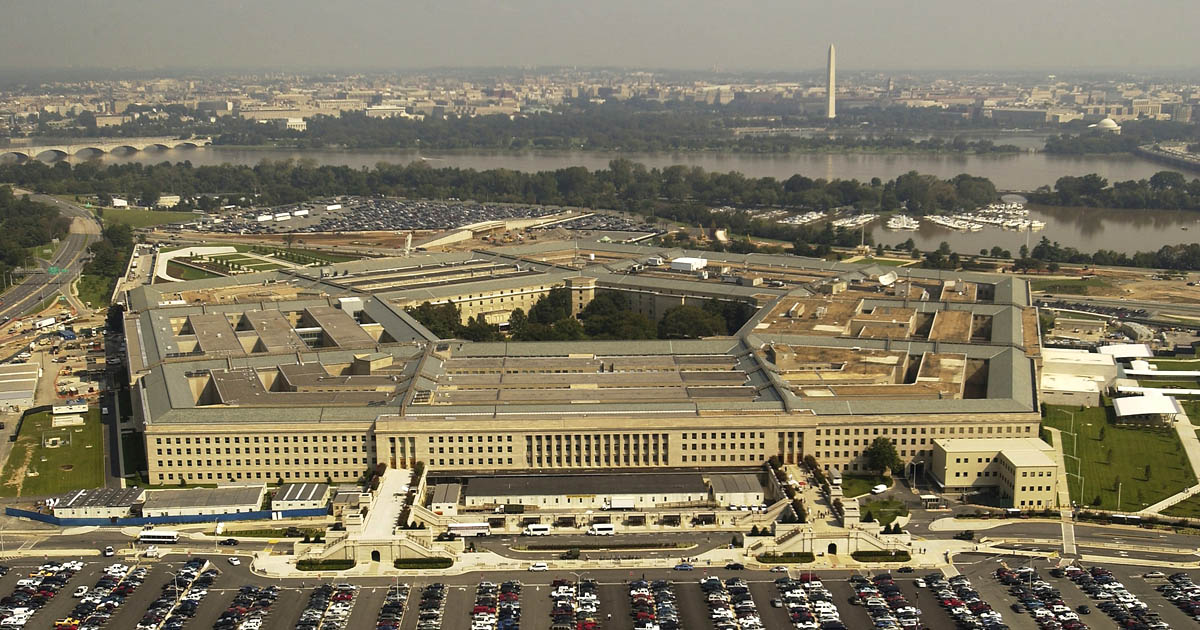
FEATURED IMAGE: The Pentagon, headquarters of the US Department of Defense, in Arlington, Virginia, near Washington, D.C. It is reputed to be the largest low-rise office building in the world.
His main aim is to be prez for life. After Zelensky told him it was normal to postpone elections in a war, he told people they may never have to vote again. If he does fix the mid-terms, that is how & why.
Thank you for this informative article. This entire edition of Toverview has been fascinating reading: very grateful!!