
By Everson Luhanga
Something big changed on Wednesday, 4 November 2026. In township wards that used to give the ANC big majorities, the Democratic Alliance (DA), still seen by many as a predominantly white party, got its strongest support from black voters in history. The DA says more than one million black South Africans voted for it. They even claim they got more black votes than the Economic Freedom Fighters (EFF).
With 99% of voting districts counted, the ANC was at about 31%, down frodm 46% in 2021, which was already down from its glory days of almost 70%.
The DA won Cape Town outright, with more than 60% of the vote, and took commanding leads in Johannesburg at about 40%, and Ekurhuleni. It also led in Nelson Mandela Bay with 44.4%, while the ANC came first in Buffalo City with 41.7% and Mangaung with 34.3%, without a majority in either. In eThekwini, Zuma’s MK emerged as the dominant force with about 34%, well short of the outright majority some polls had predicted.
Since only Cape Town produced a clear majority, the other metros, and 125 of the 196 local councils decided so far, face weeks of coalition bargaining. The IEC is due to announce the official results today.
In some township areas, the DA got 10-15%. This is not because black people suddenly fell in love with Helen Zille or Geordin Hill-Lewis. It is an angry message from people who are tired.
Tired of voting on skin colour
Tshepo Molokomme from Tembisa speaks straight: “We’ve given our own black people, our own people who thought they fought for freedom … 32 years of leading us, but yet they’re failing. The unemployment rate is high. Facilities are not delivering. We are producing more graduates, but they do not get employed. At least in these five years, let’s give Helen Zille a chance. We want to see what she can give.”
Amanda Nkosi from Alexandra is just as clear. “People want change. We have given the ANC a chance. They have been in power for the longest time, and still basic services are not getting delivered. Service delivery in most of our areas … the unemployment rate has really increased. Black people were just tired of the ANC, and they just want change.”
Sindisiwe Chauke, also from Alex, talks about the area around 16th Avenue, the illegal electricity connections, the fires, and how people cannot even walk into some yards because of the crowded shacks. “People have been having no electricity for three or six months. Is it normal? It’s a necessity. I think people opted for DA because I think umlungu will do better,” she said.
Precious Khumalo from Soweto puts it simply. People voted for the DA to show those greedy ANC leaders who have been in power for a long time without doing anything that ordinary people matter and that their votes count. She says South Africa has been a circus for too long. The country needed a stricter hand to stop the softness and the “black tax” that holds people back. “Not that we are voting for apartheid to come back, but we are voting for change,” she said. She hopes the DA will be strict, stop the crime and drugs, and simply do the right thing without cheating or eating the money.
These are not small complaints. This is the daily life that made many people stop voting for the liberation party.
The middle class votes; the poor stay home
Even an ANC leader admits the problem. Adolf Marema is an ANC councillor-elect and City of Johannesburg Chair of Chairs. He spoke honestly about why the ANC is losing.
He said the middle class complains about small things like potholes, electricity cuts and water problems. The ANC government has made it possible for the middle class to live in nice suburbs that look much better than Alexandra. Those people worry about their cars and the potholes that damage them.
But the people of Alexandra need jobs, stable electricity and the most basic things. When nothing works for them, they get discouraged and stay away from the voting stations.
Marema said white people always turn up to vote. The middle class (which now includes many black people) also turns up. But when people in Alex feel hopeless, they just stay home. That is why, in his view, the minority ends up deciding for everyone. He said the minority is thriving because the majority is not voting.
He went further. A few days before the election, there was a big storm. There was no water and no proper waste removal in many places. The middle class still went to vote because they drive cars and want the potholes fixed. The poor people who do not even own cars felt there was no point. “What is the point of voting just to get a pothole filled when I don’t have a car?” he explained.
Marema was clear: if black people united and all went out to vote, no white person would rule. But many stayed home.
ANC drops the ball
People in the townships hear this and draw their own conclusion. The party that says it fights for them has stopped giving them the basic things that make life liveable.
Tracy Zulu from Sandton saw the difference on voting day. In white and suburban areas, people came with camp chairs and cooler boxes and waited for hours. Whole families voted, including the sick and the old. Special votes were used.
In black communities, many treated the day like a holiday. In Alexandra and Tembisa, you could see men and women who should have been voting sitting in the sun and drinking. Many did not know about special votes. Some spoiled their ballots because they did not know they could ask for a new one. Others stayed home thinking they were punishing the ANC, only to realise later that not voting helped the opposition.
ANC Secretary-General Fikile Mbalula later admitted the party had dropped the ball. He said a long history in South Africa does not give the ANC an automatic right to rule. The party must now earn back voters’ respect by fixing broken service delivery and rebuilding trust from scratch.
Jobs for friends and broken trust
The real anger is about how leaders use power. Moshe Mohlala from Midrand is blunt: “Once a black leader is in charge, they can’t control finances. What they do is that they steal from the people that they should be serving … Black people only care about their political stomach. They want to empower themselves without rendering services.”
He spoke about councillors who used to live in places like Phomolong. As soon as they got the job and the salary, they moved to nearby suburbs of Clayville or Midrand. One councillor even opened a case against residents who came to ask for services, saying they had kidnapped her. “It shows that person is not a leader enough,” he said.
Vincent Ndou from Diepsloot says black people are now doing to each other what apartheid used to do. Jobs and tenders go to people from the same clan, the same network, the same faction. “You are not employed according to your qualifications. You are employed according to which clan you’re coming from.”
The job advert only comes out after the connected person has already been chosen. That is why some people decided to try the DA. In their eyes, at least the DA looks at what you can do, not which family or faction you belong to.
Brenda Yumba from Mogale City remembers what Mandela said: if the ANC does to you what the apartheid government did, then do to the ANC what you did to the apartheid government. She says people have not forgotten apartheid, but waking up every day without water and electricity under the ANC has become too painful. Some even say life felt more predictable in the old days. That is a heavy thing to say.
This anger has been showing on the streets for years. In Gauteng alone, there were 282 big service delivery protests in the five years up to March 2026. Electricity, water, uncollected rubbish and complaints about cadre deployment were the main reasons. Across the country, there are hundreds of these protests every year. In 2025 there were about 229 big ones, one of the highest numbers ever. People block roads, burn tyres and face the police because the normal ways of complaining no longer work.
Big corruption cases make the anger worse. The R255 million Free State asbestos tender is still in court, with former premier Ace Magashule facing serious charges. The VBS Mutual Bank scandal saw a lot of municipal money stolen, with senior ANC people in Limpopo involved. Bosasa cases led to a seven-year jail sentence for former ANC MP Vincent Smith. Other senior politicians were also named for taking benefits. The Zondo Commission cost the country about R1 billion, but only a few of the more than a thousand people named have been convicted. Ordinary people see the pattern clearly: public money disappears while taps stay dry.
Looking at the Western Cape and wanting what works
In the interviews, the same thinking comes up again and again. People have watched Cape Town and the Western Cape work better than Johannesburg, Tshwane and Ekurhuleni. They have seen the DA-run uMngeni municipality improve services in a place where most people are black. They are not saying white people are better. They are saying after 32 years of failure, let us try something else for one term and see what happens.
Even President Cyril Ramaphosa once admitted this. In September 2025, he told ANC councillors that the municipalities that do best are often the ones run by the DA. He said there is nothing wrong with competition and that the ANC should go and look at what Cape Town and Stellenbosch are doing. “We cannot forever stay at the bottom,” he said. Those words are now coming back to haunt the party.
EFF leader Julius Malema pointed at the ANC for helping the DA grow. He said the ANC boosted the DA’s credibility by partnering with them in the Government of National Unity and giving them high positions. Voters then asked themselves: if the ANC can work with the DA, why not vote for them directly?
Independent analyst Thabo Mopasi, who has followed communities for years, saw the shift as something that built slowly. In his view, many black voters were not suddenly becoming DA supporters. They were refusing to be taken for granted after thirty years of interrupted water, unreliable electricity, broken roads and scarce jobs.
For many, it was a conditional vote: fix my street or lose my support in five years. Local elections focus on service delivery, not history. The DA’s visible groundwork and higher turnout among its supporters also played a role, while many in the townships treated voting day like a public holiday.
Research shows the same shift. More black voters have been moving towards the DA in recent years because they link the party with better service delivery. The ANC’s support has been dropping for a long time. Local government, where people feel the failure every day, has hurt them the most. Some votes also went to ActionSA and MK, showing that people are rejecting the ANC in different ways. But the fact that many black voters crossed over to the DA is the clearest sign yet that race alone is no longer enough to win loyalty.
The hard truth
Black South Africans did not vote for the DA because they suddenly decided white people are better. They voted for the DA, or stayed home in numbers that hurt the ANC, because the party of liberation became the party of dry taps, burning transformers, jobs for friends, and councillors who disappeared into the suburbs.
The majority felt the failure the hardest and, in enough places, chose what works over skin colour. Whether the DA can actually fix the broken councils is the next test. But the message from Alexandra, Tembisa, Diepsloot, Soweto and Mogale City is already clear.
After more than 30 years, the liberation dividend is finished. Voters are now asking for results.
This article first appeared on the substack Africa Unscrambled. Used with permission.
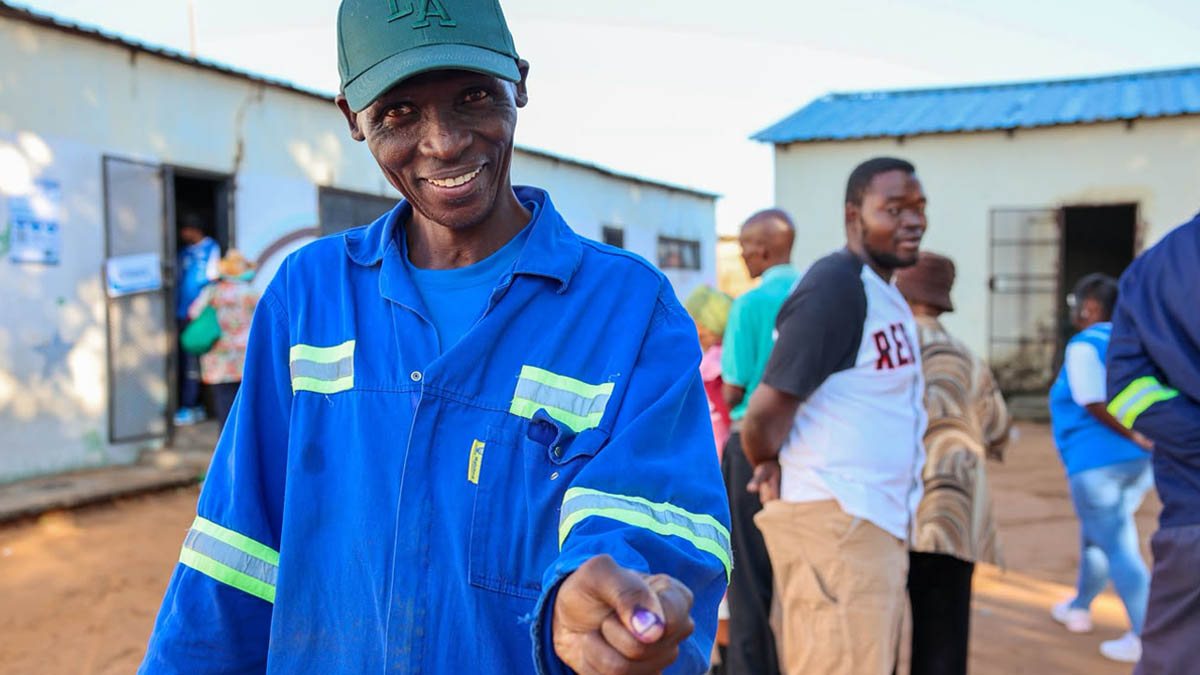
Featured image: A voter outside a polling station proudly displays the indelible ink on his thumbnail – proof that he has voted. (GCIS on Flickr)
͏ ͏ ͏ ͏ ͏ ͏ ͏ ͏ ͏ ͏ ͏ ͏ ͏ ͏ ͏ ͏ ͏ ͏ ͏ ͏ ͏ ͏ ͏ ͏ ͏ ͏ ͏ ͏ ͏ ͏