
By R.W. Johnson
South African Airways has slipped off the radar for most people. People remember that it was loss-making for many years, that it swallowed enormous sums in bail-outs paid by the reluctant taxpayer, that it finally ended up in business rescue, which at least brought the bail-outs to an end, and that now, as a greatly shrunken airline – fewer planes, less routes – it soldiers on making modest profits, a mere shadow of its former self.
It now turns out, however, that that picture is untrue in important respects and that some decidedly funny business has been going on at the state-owned airline. The financial results for 2025 have just been published – ten months late. The results for the previous year were delayed in similar fashion, and no explanation has been offered in either case. The Auditor-General, Tsakani Maluleke, has issued a disclaimed audit opinion, which means that the financial statement is misleading and that the figures it cites are not credible.
The statement had claimed that the airline made a profit of R155 million but it turns out that operating costs exceeded revenue so there was really a loss of R317 million before tax. Moreover, the results for 2024, which also arrived ten months late without explanation, had contained a similar misrepresentation. Again, a profit of R71 million had been declared which, on further inspection, turned out to have been a loss of R354 million.
Simultaneously, SAA’s CEO, Professor John Lamola, resigned suddenly, with effect from the end of April 2026. (In case you’re wondering what his expertise is, he teaches African Social Philosophy and the Philosophy of Technology at the University of Johannesburg.) He was previously the corporate affairs manager and then the CEO of Denel Aviation and served five years on the Board of the Airports Company of SA before joining the Board of SAA, first as chairman and then as CEO, so his academic career has been greatly interrupted by this series of lucrative state appointments.
At the same time three other Board members resigned for reasons unknown. Equally startling, Prof. Lamola’s successor as CEO is Matshela Seshibe, the CEO of Air Chefs, the SAA subsidiary which provides in-flight meals. He thus has no expertise in aviation. Moreover, Mr Seshibe had to leave his previous job at Daybreak Farms because he was suspended for governance failures.
In announcing his resignation Prof. Lamola said that it had been “the honour of my life” to have served as SAA’s CEO. He did not offer any explanation for the roughly R5 billion in irregular expenditure which has occurred at SAA during his four years as CEO. Another oddity was that the airline’s Chief Financial Officer, Lindsay Olitzki, had taken early retirement just one day before the end of the financial year in March 2026.
Further examination of the results for 2025 shows that there was R500 million in irregular expenditure and that despite running at a loss SAA had nonetheless somehow found the money to give its executives and directors large salary increases. Moreover, the results were really far worse than the numbers suggested because revenue had been boosted by selling two of the airlines precious and irreplaceable landing slots at Heathrow for R1.17 billion. And SAA had issued over R1 billion in new shares to its sole stakeholder, the South African government.
Professor Lamola says that this was just a matter of the government reimbursing SAA for business rescue liabilities, but this does not explain how an SOE, already wholly owned by the state, could issue unmarketable shares in an enterprise clearly on its way to bankruptcy.
At various points since 2012 SAA has claimed to have “made the first profit since 2012”, but such claims should be disregarded. Closer examination reveals a great deal of wishful accounting and the main fact is that SAA has received over R57 billion in bailouts since 1994. Plus, of course, the R511 million in Airlink ticket sales which SAA effectively stole from Airlink: it sold the tickets for seats on Airlink and then just kept the cash. Moreover, as part of business rescue SAA’s creditors were forced to write off 92% of all the debts owed to them by SAA.
Meanwhile, there is news of a criminal conspiracy involving SAA employees and the theft of valuable plane parts. That sort of thing can be more or less expected when those in charge are running such an obviously dodgy show. Employee morale can hardly be very high.
All of which poses many questions. First, why haven’t we heard from the DA about this ? This is a first rate scandal and the government is responsible for keeping this dead horse of a company running. How can an SOE have such dodgy accounting that claimed profits turn out to be losses on closer examination ? And how can an SOE – of all companies – present accounts so unreliable that the Auditor-General has to issue a disclaimer ?
How can a major SOE have CEOs – a philosopher and a caterer – without any expertise in the field of operation ? How on earth has R5 billion in irregular expenditure occurred ? How can the executives and directors all be getting large salary increases when the SOE in question is running at a loss ? And given that the airline has been running at a loss for years now, who is picking up the bill for that ? Are large debts being run up in the tax-payer’s name ? There is, indeed, almost no end to the relevant questions to be asked. Has this been discussed at Cabinet level ? And if not, why not ?
Secondly, what explains the airline’s whole trajectory since 1994 ? At the start of that period SAA had run for sixty years and was profitable. Year in, year out it won awards as Africa’s leading airline. It was prestigious, it had an up-to-date fleet of planes and on the key routes to Europe and America it was competitive with the major international airlines. So what exactly went wrong to explain the airline’s descent to its present parlous state ? As yet we have not been offered any real explanation.
Now it is true that the last thirty years has been a time of great change and consolidation in the airline business. Household names like Pan-Am and TWA have disappeared. Cut price airlines like RyanAir have appeared all over the place. And many regional or smaller national airlines have been amalgamated with larger ones: BA took over Iberian Airways, Air France now owns KLM and Lufthansa owns 41% of what used to be Alitalia but is now ITA, an Italian state company.
Given that situation, SAA had a choice: either it could agree to be taken over, at least in part, by a larger airline, or it could have gone all out for growth on the assumption that the market had room for at least one or two large African carriers. That has indeed turned out to be the case: today the market is led by Ethiopian Airlines (which has a fleet of 170 planes serving 161 destinations) and Royal Air Maroc (65 planes serving 108 destinations). Both are state-owned but run very competitively and both are profitable.
Moreover, Ethiopian owns 49% of Air Congo, Guinea Airways and Malawi Airlines, 45% of Zambia Airways and 27% of Asky Airlines (Lome) – which is to say, it is clearly building an Africa-wide network as well as serving a full suite of international destinations. In 1994 SAA was far better placed to do that but instead it made larger and larger losses, necessitating ever greater bail-outs.
In 1996 Robin (Lord) Renwick, whom I knew from previous connections, told me that he had just arrived in Johannesburg where he was mandated by BA, of which he was a director, to make an offer for SAA. He later told me that the South African government was happy to sell up to 49% of the airline, whereas BA wanted 51% with full management control. That was the sticking point.
BA had no interest in being the junior partner in a South African state enterprise subject to South African labour laws and possible political interference, while the government was determined not to lose management control. As a result BA pivoted and instead bought a controlling interest in Comair, which was henceforth run as a BA franchise until it was liquidated as a result of Covid-19.
This was a considerable lost opportunity. Had the BA offer been accepted, the government would have got a good price and it would never have had to waste prodigious sums on bail-outs. SAA would have been securely part of a huge international network and would have been run on a highly professional basis. Instead, SAA was run into the ground, went bankrupt and what little remains of it is probably not sale-able: there has been a huge destruction of value.
For the government the problem about the BA offer was not just one of a jealous feeling of sovereignty. Already the international airline market was feeling strong pressures towards consolidation and many African airlines were going bust or being bought out. However, the ANC wanted political control of SAA and so one of its activists, Cheryl Carolus, was made CEO of SAA and she was then followed by one of Jacob Zuma’s key supporters, Dudu Myeni. It is doubtful if either of these two women really understood the international aviation market.
But from the point of view of the ANC elite, the main point about SOEs was not the usual rationalisations about nationalised industry: it was pillage. SOEs with their vast procurement power meant wondrous possibilities for tenderpreneurship. The fact that the SOEs were backed up by the state treasury meant that even vast irregular expenditure or annual losses could be paid for by bail-outs.
And corruption wasn’t just about stealing and fraud. Salaries were inflated, sometimes to extraordinary lengths – Eskom is not only several times over-staffed but its average salary for all employees is well over R1 million a year. If any of the SOEs were privatised any private owner would slim down the payroll, downwardly adjust salaries to normal levels, get rid of procurement fraud and generally spoil the party for everyone else.
SAA got its first African CEO, Khaya Ngqula, in 2007. He behaved rather as if trying to prove a certain stereotype of black management, lavishing huge bonuses on managers although the airline was loss-making, and using SAA planes to fly himself and his friends all over the world. Naturally, he also received very large remuneration. This junket lasted for two years before he was sacked, though in his final year he received R13.65 million, including a R9.3 million golden handshake – later the subject of litigation.
However, this turned out to be merely a prelude to the Zuma period when Dudu Myeni was put in charge of SAA, opening the door to outright plunder. Ultimately the Zondo Commission had much to say on the subject and Myeni was declared a Delinquent Director, banned from ever holding a similar position again. It is remarkable that she escaped jail.
At the end of all this SAA emerged from bankruptcy and business rescue with just five planes. At which point the sensible thing to do would have been to sell off whatever remained and close the chapter, for it was quite clear that SAA could never recover. But the government did not want to admit that it had completely destroyed this iconic company, once the source of much national pride and by its very nature a symbol of modernity.
So we then had the long charade of the supposed takeover of SAA by the Takatso consortium, itself the child of the Public Investment Corporation. It was never revealed how Takatso had been chosen, whether there were any rival bidders or how on earth SAA was supposed to become a viable enterprise again. Ultimately, the deal collapsed anyway and SAA has continued on its dodgy way with a fleet of dated, fuel-inefficient planes which cannot possibly be competitive, with heavily massaged and misleading accounts and CEOs with no aviation background.
The current situation is scandalous, and there ought to be a thorough investigation of how and why things have been allowed to progress towards this juncture. The airline needs to be wound up, embarrassing though that would be for the ANC. The Post Office too is being kept on life support – another SOE brought to ruin by ANC mismanagement and corruption. In the end these failures have to be admitted and lessons learnt. There is no other way.
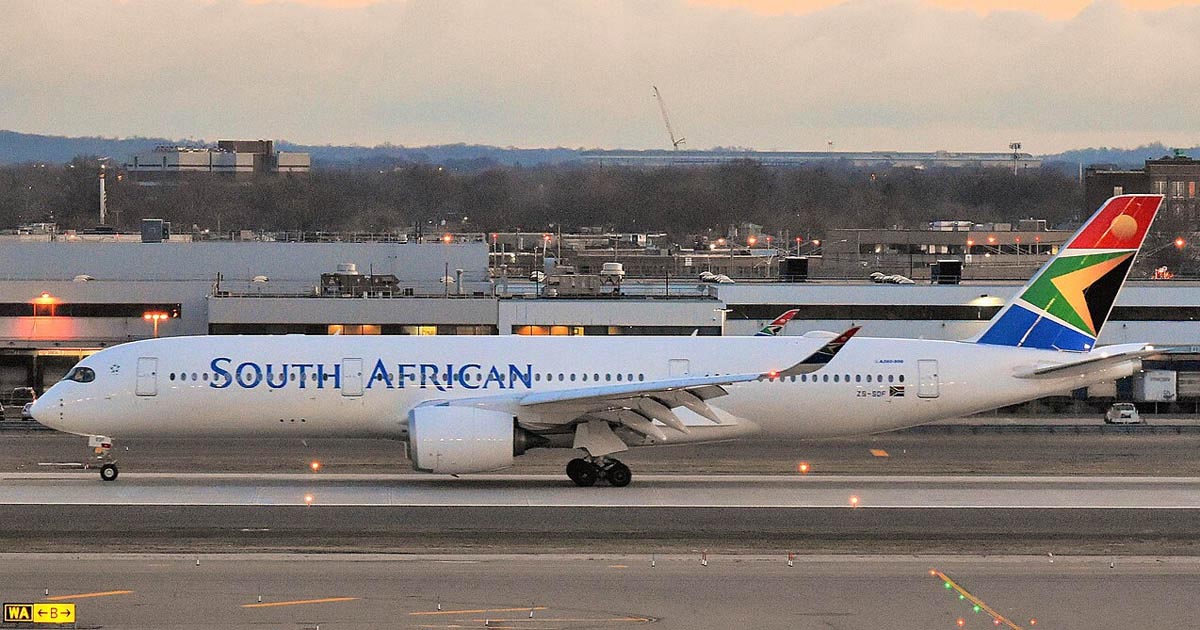
An SAA Airbus A350-900 arrives at John F. Kennedy airport in New York, 2020. It no longer operates these aeroplanes. (Adam Moreira / Wikipedia ]
Absolutely tragic. Thanks for this.